What this page does and does not claim
The owner of Solid Rock Fencing was raised Amish and chose fencing to bring the quality Amish builders are known for to fence and gate work. That is the whole of the personal story we tell here. We are not going to describe how Amish builders in general set a post or hang a gate, because we cannot speak for every community and crew, and the research we reviewed does not document it.
What we can do is explain what any careful builder pays attention to, with figures from university extension services and government agencies. If you are weighing an Amish crew against another builder, these are the details worth asking about. Our post on what to look for in an Amish-built fence covers how to vet any builder, and you should verify licensing and insurance for all of them.
Posts and gates are where fences fail
Wood posts rot first at the ground line. The USDA Forest Products Laboratory says decay is most severe where soil moisture meets air, and Kentucky Extension says the same. In a 30-year Forest Service test of ponderosa pine, every failure was butt decay at or near the ground line. Gates fail where weight meets the hinge post, a twisting load that line posts never see.
A builder who spends extra time on those two places is spending it where the fence needs it. That is common sense and it does not belong to any one tradition. It does show up in how a builder talks. Listen for how deep, how large, how braced and how drained, and be wary of answers that stop at the finish.
Depth and size, in the numbers extension offices give
- Penn State Extension: typical line post depth is 36 inches. Corner and gate posts are about 25 percent larger in diameter and set about 48 inches deep.
- University of Wisconsin Extension: a 40 to 48 inch livestock fence ideally has posts buried 4 feet deep, generally below the frost line in northern climates.
- University of Georgia Extension: corner and gate posts should be at least 8 inches across the top.
- Ohio NRCS: wood line posts at least 30 inches below ground on woven wire fence, and H-brace posts 3 feet deep with 8 foot posts.
- Local frost depth in the Ohio and Pennsylvania places we checked ranges from about 30 to 42 inches. Your township or building department sets the number for your address.
The sources differ because fences differ. A horse board fence, a woven wire cattle fence and a chain link run do not use the same numbers, and soil changes things further. The useful question for a builder is why their depth fits your fence, not whether they match a single figure.
Frost, drainage and what goes in the hole
National Research Council Canada says frost heave needs a freezing plane, soil that moves moisture and a water supply. Fine sands and silts are very susceptible, and 4 to 8 inches of lift is common in susceptible soils. University of Wisconsin Extension says freeze-thaw in silt and clay can push dug posts out of the ground, and recommends backfilling with sand and gravel, tamped as you go. Wisconsin also warns that cement placed only at the top of a hole can help heave posts.
Concrete is not wrong, and the sources do not say it is. The Forest Products Laboratory advises that concrete reaching the surface can trap water against the post, so concrete anchorage should stay at least 6 inches below ground line. Tennessee Extension says driven posts are 1.7 times as strong as tamped posts, and Penn State recommends driven posts over hand-set ones for horse fence. Each method has a place, and a builder should be able to say which one they use at the corner, at the gate and on the line, and why.
Why corners and ends need bracing
A wire fence puts a constant pull on its ends. University of Georgia Extension says a corner or end can see about 3,000 pounds of pull when wire is first stretched, and about 4,500 pounds in winter cold. University of Wisconsin Extension says bracing keeps end and corner posts from tipping or pulling out, and that deep burial alone may not hold against that pull.
The H-brace is the common answer. Wisconsin puts the brace post 8 to 10 feet from the braced post, set as deep as the end post. Ohio NRCS requires braces at all corners, gates, pulls and ends on woven wire fence, with no more than 660 feet between pull assemblies for standard woven wire. Maine NRCS and Ohio NRCS give different depths for the posts, so a single figure would mislead. The point is that bracing exists, and that a builder can show you where it is.
What goes into a gate that keeps hanging right
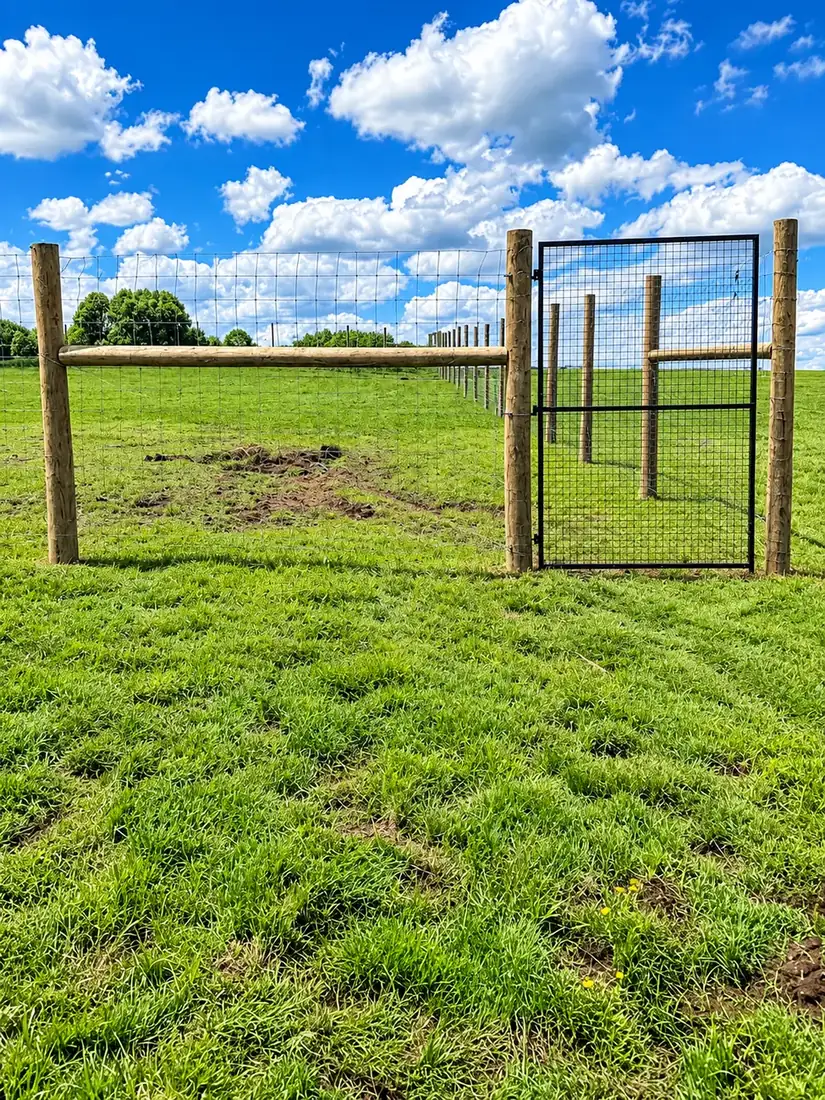
Start with the hinge post. For a 14 to 16 foot farm gate, Grainews suggests a wood post 6 to 8 inches in diameter or a 6 inch pipe, with a concrete thrust block around the bottom 10 to 12 inches, at least 30 inches deep. Grainews also describes a diagonal wire or cable from the top of the gate post to the next post to share the load. Our post on why gates sag and how to fix them goes through the causes.
Then the hardware. Michigan State University's chain link spec says hinges, stops, drop rods and keepers should be structural steel, sized to keep hinges from twisting and to hold the gate level with the fence. Grainews says to drill hinge holes level and adjust the hinge nuts until the gate hangs level.
Then the width and height. Penn State says tractor and vehicle gates should be at least 12 feet and no wider than 16, and that a gate should be as tall as the fence. For horses it recommends tubular steel gates and no diagonal cross bracing on the gate itself, since that can trap legs and heads. University of Georgia says to avoid gaps between gates and supporting posts. See our gates page for what Solid Rock Fencing builds.
Practical and traditional are different things
Builders of every background use some methods because they work and some because that is how they were taught. Extension research tests the first kind. A method you cannot explain by what it does for the post, the gate or the ground is worth a question, and a good builder will not mind being asked. Our about page has the owner's story in a few lines. The best evidence is a fence a few winters old, and we are glad for you to look at ours and compare it with others.
Call 811 before any digging, whoever builds. OHIO811 asks for notice at least two working days ahead in Ohio, and Pennsylvania's utility commission says three business days. Solid Rock Fencing builds fences and gates in Ohio and Pennsylvania, is locally owned and operated, and offers FREE estimates at (440) 241-4312. Verify licensing and insurance for any builder you hire, including us.
Get your FREE estimate
Tell us what you are fencing and where. We will talk it through with you and come out to walk the line.
Questions we hear
Do Amish builders set posts differently?
We cannot say. Communities and crews differ, and the sources we reviewed do not document a single method. Ask any builder how deep, how large and how braced their posts are, and why that suits your soil and fence.
How deep should a gate post go?
Penn State says about 48 inches, with a diameter about 25 percent larger than a line post. Grainews suggests at least 30 inches for a concrete thrust block on a big gate. Local frost depth matters, so confirm with your township and your builder.
Why do corner posts need braces?
Wire pulls on corners and ends constantly. University of Georgia Extension says the pull can reach about 3,000 pounds at first stretch and about 4,500 in winter cold. A brace shares that load so the post does not tip.
Is the owner of Solid Rock Fencing Amish?
He was raised Amish and chose fencing to bring the quality Amish builders are known for to fence and gate work. Solid Rock Fencing is locally owned, operated and family owned. Verify licensing and insurance with any builder.
- USDA Forest Products Laboratory, Protecting Wood Fences for Yard and Garden (1979)
- Kentucky Extension, Fence post treatment (FORFS 03-05)
- USDA Forest Service RM-300, ponderosa pine post test
- Penn State Extension, Fence Planning for Horses
- University of Wisconsin Extension, Setting fence posts
- University of Wisconsin Extension, Bracing
- University of Georgia Extension, Circular 774, Fences for the Farm
- University of Georgia Extension, Bulletin 1192, Fences for Horses
- Ohio NRCS woven wire fence specification (2016)
- Maine NRCS, how to build an H brace
- National Research Council Canada, CBD-26 Frost action
- University of Tennessee Extension, PB1541
- Grainews, Tips to prevent and fix a sagging livestock gate (2016)
- Michigan State University chain link fences and gates spec
- OHIO811, when and how to notify
- Pennsylvania PUC, PA One Call