Who field and woven wire fence suits
Field and woven wire fence suits farms with mixed or small stock, long property lines and fields that need a tight bottom. It is the mesh fence you see along pastures, with horizontal line wires tied together by vertical stay wires. It holds sheep, goats and calves where a few strands of wire would not, and it keeps dogs and small wildlife out of a garden or a hay field.
Solid Rock Fencing builds field and woven wire fence in Ohio and Pennsylvania from our base in Bristolville. It often pairs with a top board or a barbed or electric strand, and it needs strong ends. For the wider picture see the farm and ranch fence page. If horses are involved, read the horse fence page first, since mesh pattern matters for them.
- Pastures with sheep, goats or young stock that slip through open strands.
- Long runs where wood rail would cost more than the job justifies.
- Garden, orchard and yard fence meant to keep dogs and small animals out or in.
- Property lines that need a legal livestock fence in Ohio, since woven wire is part of the preferred partition fence.
What woven wire is made of
Woven wire is steel wire in two directions, a set of horizontal line wires spaced closer at the bottom, tied to vertical stay wires at set intervals. The details that decide how well it works are the wire gauge, the zinc coating, the stay spacing and how the wires are joined. University of Georgia Extension describes woven wire fence as 26 to 48 inches high, with horizontal wires about 1.5 inches apart at the bottom and up to about 9 inches apart at the top.
Gauge
Wire gauge is a thickness number where a lower number means thicker wire. The Ohio NRCS woven wire specification calls for standard woven wire with top and bottom wires of 10 gauge or heavier, intermediate wires and stays of 14.5 gauge or heavier, stays no more than 12 inches apart, and staples of 9 gauge. High tensile smooth wire is 12.5 gauge. UGA gives an example with 11 gauge stays and intermediates and top and bottom wires two sizes heavier.
Galvanizing
Galvanizing is the zinc coating that slows rust, and heavier coating lasts longer. UGA says Class 3 galvanizing has roughly two to three times the zinc of Class 1, and that it can easily add 5 to 10 years of life to fence wire in a humid climate like Georgia's. That is a Georgia figure and not an Ohio one. The Massachusetts NRCS standard calls for 12.5 gauge high tensile wire at 170,000 psi with Class 3 galvanizing. When you get a quote, ask which class the wire is.
| Wire detail | What the sources say | Why you care |
|---|---|---|
| Top and bottom wires | 10 gauge or heavier (Ohio NRCS) | They carry the load when stock pushes. |
| Intermediate wires and stays | 14.5 gauge or heavier, stays no more than 12 inches apart (Ohio NRCS) | These set the mesh pattern. |
| Staples | 9 gauge (Ohio NRCS). UGA says 8 or 9 gauge, hot-dip galvanized, 1.75 to 2 inches long. | A weak staple lets good wire pull away from a good post. |
| Coating | Class 3 is the heaviest standard galvanizing (UGA) | More zinc slows rust at cut ends and in wet ground. |
| High tensile | 12.5 gauge, about 170,000 psi, Class 3 (Massachusetts NRCS) | Carries load at the ends and corners, so the ends must be built for it. |
Knot types and stay spacing
Stay spacing is the choice that most affects safety for the animal. The University of Illinois found that 2 by 6 inch stays stop animals from sticking their heads through, 6 by 6 inch stays can trap animals, and 6 by 12 inch stays let animals pull their heads back without getting caught. Langston University says 12 inch stays are preferred for horned goats because 6 inch stays can catch horns and trap the goat.
The wire joint comes in two common forms. A fixed knot is a rigid wrap that holds the stay square to the line wire, and a hinge joint is a wrap that lets the stay flex. Makers sell both in several heights and stay spacings. We cannot cite a study that ranks them, so ask the builder which product is in the quote and why it was chosen for your stock.
| Animal | Stay spacing guide | Notes |
|---|---|---|
| Cattle and large stock | UGA gives 12 inch stays for large animals | Taller fence, often with a top strand. |
| Small stock | UGA gives 6 inch stays for small animals | Check horned animals against the Langston note. |
| Sheep | Illinois: 2 by 6 stops heads going through | Ohio NRCS gives 42 inches minimum height. |
| Goats | Langston: 12 inch stays for horned goats | Langston says a 48 inch fence will contain goats except under extreme circumstances. |
| Horses | Illinois and UGA: 2 by 4 inch mesh, V-mesh or square knot | See the horse fence page for safety limits. |
Stretching and bracing woven wire
Woven wire is stretched tight between braced ends, and the bracing does most of the work. UGA says a corner or end post can see about 3,000 pounds of pull when wire is first stretched, rising to about 4,500 pounds in winter cold. That pull is why every end, corner, gate and long pull needs a brace assembly.
- Set the end and corner assembliesPosts and H-braces go in first and are left to settle before wire goes on.
- Roll the wire out along the lineUnroll it along the fence line and check the height, the stay spacing and any damage.
- Stretch with a stretcher barTension is applied across the whole height of the wire, not at one strand.
- Fasten to the line postsStaples are driven so the wire is held but not crushed, and the hold is checked on the way.
- Tie off at the next assemblyWire is cut and tied to the end post, then the line is checked for even tension.
- Check the tension againWire settles, so the line is looked over after it has had time to work.
Langston University says to stretch woven wire until the kinks flatten to about two-thirds of their original height, and that straightening them fully is not recommended. Ohio NRCS allows no more than 660 feet between pull assemblies on standard woven wire, or 1,320 feet on high tensile woven wire.
The H-brace is the usual assembly. University of Wisconsin Extension places the brace post 8 to 10 feet from the end post, and says it can be slightly smaller than the end post but must be set just as deep. Ohio NRCS asks for the horizontal cross member to be 4 to 5 inches in diameter and at least 8 feet long, with H-brace posts 3 feet deep when posts are 8 feet long, and 4 feet or deeper with 9 foot posts in deep or sandy soils.
Wood posts versus steel posts
Wood posts suit the ends, corners and gates, and steel posts can serve as line posts when the ground and animals allow. Ohio NRCS asks for wood line posts at least 30 inches below ground and steel line posts at least 21 inches, and says if soil depth is under 28 inches, use steel T-posts. It allows line posts up to 16 feet apart on standard woven wire and 18 feet on high tensile woven wire.
| Post | Where it works | Watch for |
|---|---|---|
| Wood line post | Where you want strength and a longer spacing | Must be rated for ground contact. Rot starts at the ground line. |
| Steel T-post | Shallow soils, back fields, temporary or cross fence | Penn State says metal and fiberglass T-posts are not recommended for horse fence because of impalement risk. |
| Heavy wood line post | Wire along a road, in a wind or snow lane, or where stock lean | Larger and heavier, so it resists leaning when stock push. |
| Wood end or corner post | Every end, corner, gate and pull | Penn State describes these as about 25 percent larger than line posts and set about 48 inches deep. |
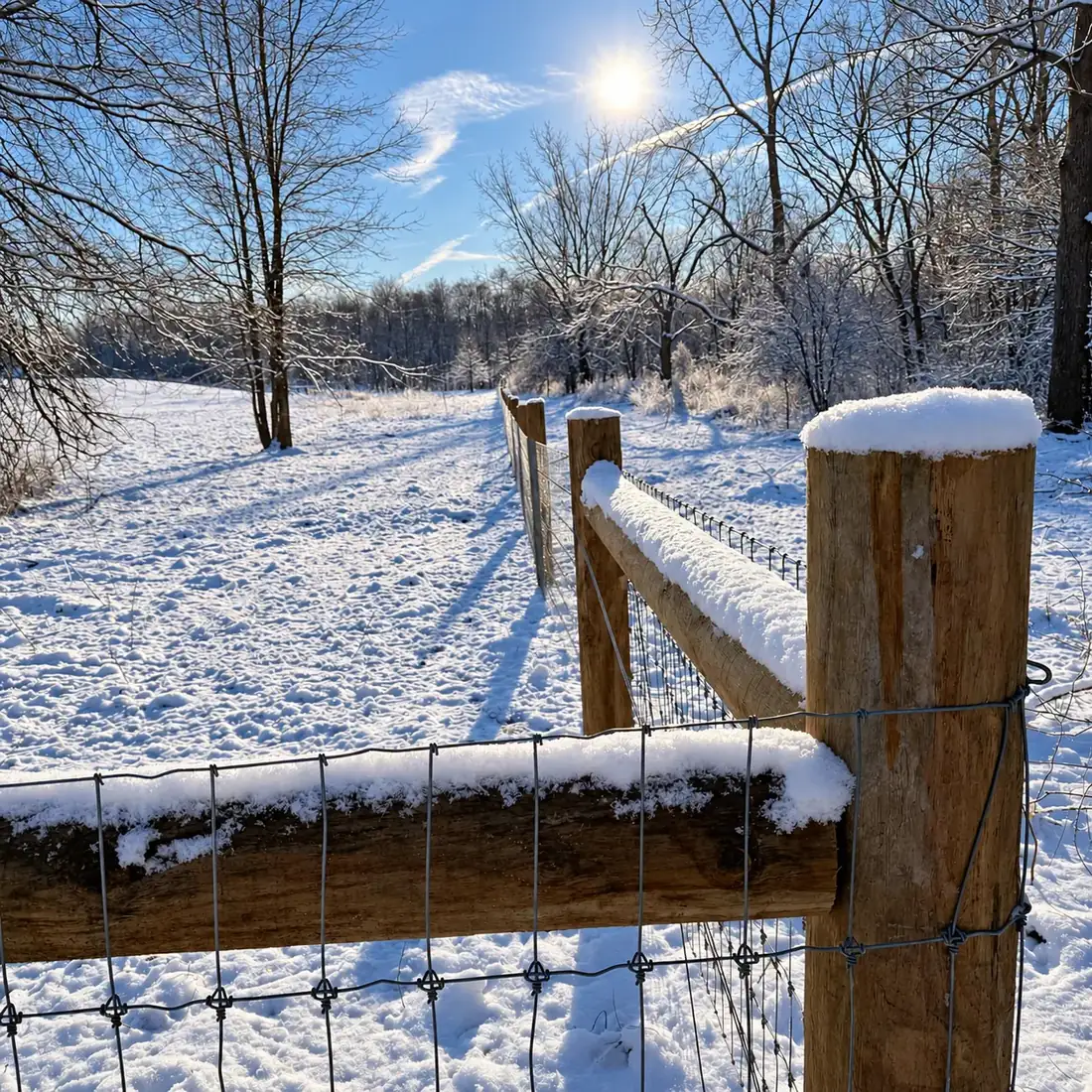
Our job photos include a heavy post carrying woven wire through snow. Heavy posts like that do two things in cold country. They resist leaning when stock push, and they stay put when the ground freezes. University of Wisconsin Extension says freeze-thaw in silt and clay soils can push dug posts out of the ground, so sand and gravel backfill, tamped as you go, is the usual answer. National Research Council Canada says frost heave needs fine-grained soil, water and a freezing plane. Posts set below local frost depth resist heave.
Dogs, sheep, goats and deer
Each animal looks for a different weakness in mesh, so the stock decides the details. A fence that works for sheep can fail for a determined dog or a goat that climbs. The heights and patterns below are what the sources give. Where they give no number, we say so.
- Dogs. Mesh with close horizontal wires near the ground is harder to squeeze under. Our research found no sourced dog fence figures, so we judge by the dog, the soil and whether the bottom edge needs extra attention. A determined digger may need more than mesh.
- Sheep. Ohio NRCS gives 42 inches minimum, and University of Tennessee says barbed wire is less effective because barbs collect wool.
- Goats. Langston says 48 inches contains goats except under extreme circumstances. Oklahoma State says woven wire for goats should be at least 39 inches high.
- Deer. Our research found no sourced deer fence height, so we do not quote one. Deer fence is a separate design question, and a tall fence puts far more load on posts and bracing than a pasture fence does.
Repairing slack woven wire
Slack woven wire usually means a post has moved, a staple has pulled, or the wire has stretched, and the fix starts with the cause. Retightening a line against a leaning end post only moves the problem down the fence. Our fence repair service covers this work, and many fence companies only build new fence.
- Find the causeWalk the line and look at the end posts, braces and the lowest wire first.
- Fix the anchorReset a leaning end or add a brace before touching the wire.
- Restaple or splicePulled staples are replaced with 9 gauge ones, and a broken wire is spliced.
- Restretch to the kinksTension is brought back until the kinks flatten to about two-thirds of their height.
- Replace what cannot be savedVirginia Tech says smooth wire needs replacing when rusty or stretched.
Mississippi State Extension notes that when a corner post moves half an inch, mild-steel barbed wire loses over 20 percent of its tension, against about 10 percent for high tensile.
Common failures and what causes them
| What you see | Likely cause | Fix |
|---|---|---|
| Sagging line between posts | Wire stretched, staples loose, or a post moved | Restretch after checking the posts. |
| Leaning corner or end | Weak or missing brace, shallow post, or frost push | Reset the post and add a proper H-brace. |
| Broken stays or line wires | Animals pushing, a fallen limb or a pulled staple | Splice or replace the damaged panel. |
| Rust at the ground line | Moist soil against wire, or light galvanizing | Replace the section and clear soil and weeds off the wire. |
| Wire pulled off a post | Staples too short or driven against the grain | Replace with 9 gauge staples, set so they do not run parallel to the grain. |
| Rotted wood post | Rot concentrates at the ground line | Replace the post and use ground-contact treated wood. |
Mistakes to avoid
- Stretching wire before the ends are braced and settled.
- Choosing a stay spacing that can trap a head or horn.
- Using lumber rated only for above-ground use as posts.
- Pulling woven wire flat to remove every kink. Langston says not to.
- Running barbed wire in a goat, sheep or horse field.
What affects the price of field and woven wire fence
Solid Rock Fencing offers a 10 year workmanship warranty, with written terms provided with the estimate. It covers workmanship defects, not weather, impact, animals or normal wood aging.
Call 811 before any digging. Ohio uses OHIO811 and Pennsylvania uses PA One Call, and our call 811 page explains who calls and when.
Get your FREE estimate
Tell us what you are fencing and where. We will talk it through with you and come out to walk the line.
Questions we hear
What gauge woven wire fence do I need?
The Ohio NRCS specification calls for top and bottom wires of 10 gauge or heavier and intermediate wires and stays of 14.5 gauge or heavier, with stays no more than 12 inches apart. A lower gauge number is thicker wire. Ask your builder for the gauge and the galvanizing class in writing.
How tight should woven wire be stretched?
Langston University says to stretch woven wire until the kinks flatten to about two-thirds of their original height, and not to straighten them fully. The ends and corners must be braced first, because the pull is about 3,000 pounds at first stretch and about 4,500 pounds in winter cold, per UGA.
Is woven wire fence good for goats and sheep?
Yes, with the right stay spacing. The University of Illinois says 2 by 6 inch stays stop heads going through, while 6 by 6 inch stays can trap animals. Langston prefers 12 inch stays for horned goats. Ohio NRCS gives 42 inches minimum for sheep, and Langston says 48 inches contains goats.
Can I use steel T-posts with woven wire?
Often yes for line posts, and Ohio NRCS says to use steel T-posts if soil depth is under 28 inches. Ends, corners and gates should still be larger and braced. Penn State says T-posts are not recommended for horse fence because of impalement risk.
Will woven wire keep deer out?
Not by itself. Our research found no sourced deer fence height, so we do not quote one. A deer fence is a separate design with its own height and post load, and a regular pasture woven wire fence is not built for it. Tell us about the deer pressure on the walk-through.
How do I fix a sagging woven wire fence?
Find the cause first. A leaning end post or weak brace needs resetting before the wire is restretched. Pulled staples are replaced and broken wires spliced, and Langston says to stretch until the kinks flatten to about two-thirds. Our fence repair service does this work. Call (440) 241-4312.
Is woven wire part of an Ohio legal livestock fence?
Yes. ORC 971.01 defines a preferred partition fence as woven wire, standard or high tensile, with one or two barbed wire strands at least 48 inches above ground, or a nonelectric high tensile fence of at least seven strands. Neighbors can agree otherwise in writing. Rules vary by township, so check locally. This is not legal advice.
- USDA NRCS Ohio, Woven Wire Fence specification (2016)
- University of Georgia Extension, Fences for the Farm (Circular 774)
- University of Tennessee Extension, Fencing for Livestock (PB1541)
- Illinois Extension, Safe Fencing for Horses
- University of Illinois, sheep and goat fencing
- Langston University, goat fencing
- Oklahoma State Extension, Meat Goat Production, fencing chapter
- University of Wisconsin Extension, bracing fence ends and corners
- University of Wisconsin Extension, setting fence posts
- USDA NRCS Massachusetts, Fence standard 382 (2011)
- Penn State Extension, Fence Planning for Horses
- Virginia Tech Extension, horse fencing (1999)
- Mississippi State Extension, livestock fencing systems
- National Research Council Canada, frost heave (CBD-26)
- Ohio Revised Code 971.01
- University of Missouri Extension, G1193
- City of Columbus, climatic design (frost depth)
- City of Cleveland, climatic and geographic design
- Penn State Housing Research Center, soil freeze depth guide
- Poland Township, fences and walls regulations
- OHIO811 homeowner page
- Pennsylvania One Call, FAQs for homeowners