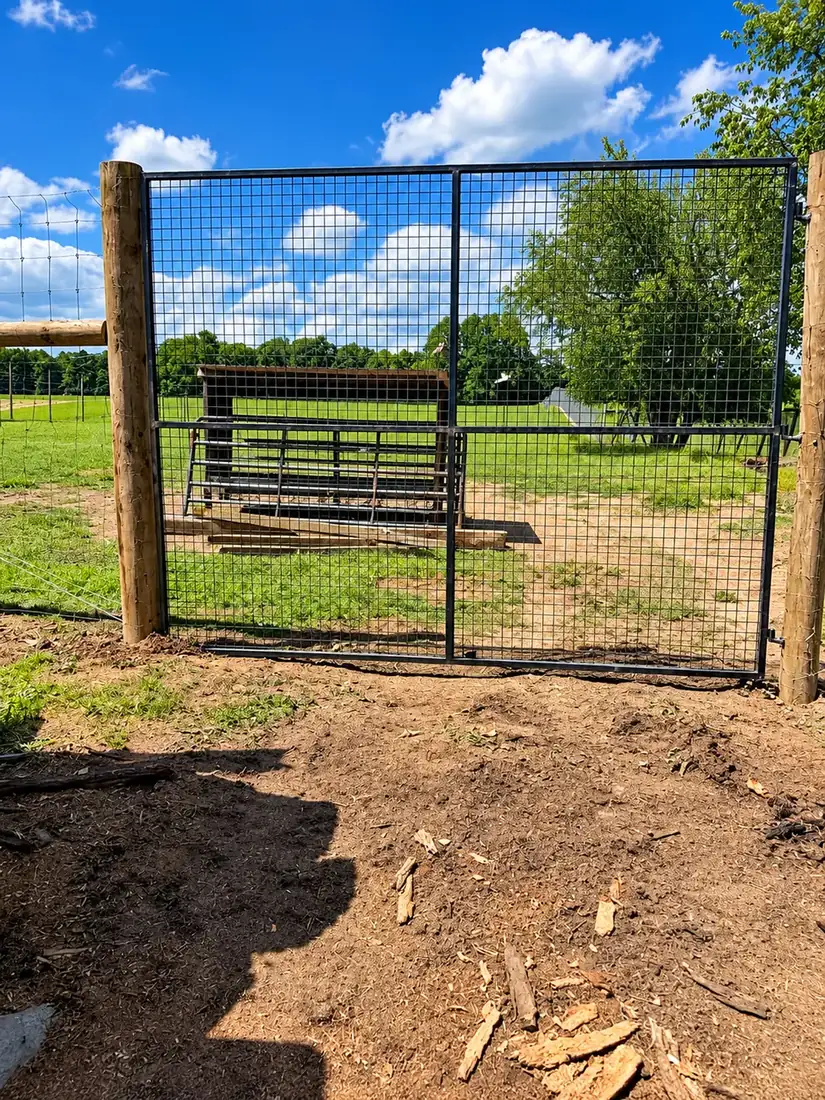
Who gate work suits
Gate work suits anyone whose fence has an opening that gets used, which is every fence. A farm needs gates wide enough for the tractor and strong enough to swing for years. A horse owner needs gates that lead safely and latch reliably. A homeowner needs a drive gate that clears the car and a walk gate that clears the wheelbarrow. The gate is the moving part of a fence, so it is also the part that fails first.
Solid Rock Fencing builds walk gates, farm gates and drive gates in Ohio and Pennsylvania from Bristolville, and we also repair gates that sag, drag or will not latch through our fence repair service. Gates sit inside a larger plan, so the farm and ranch fence page and the horse fence page are worth a look too.
Walk, farm and drive gates
A walk gate moves people, a farm gate moves stock and machines, and a drive gate moves vehicles. Each has a different width, post and hardware, and mixing them up is the start of most gate problems.
| Gate | What it is for | Width guidance from the sources |
|---|---|---|
| Walk gate | People on foot, a wheelbarrow, a mower or a lead horse | Penn State says horse and handler gates should be at least 4 feet, with 5 feet preferred. We found no neutral source for residential walk gate widths, so measure what must pass. |
| Farm or pasture gate | Tractors, mowers, livestock trailers and herds | UGA says pasture gates for tractors and mowers should be 14 to 16 feet. Penn State says vehicle and tractor gates should be at least 12 feet, with a maximum of up to 16 feet. |
| Drive gate | Cars and trucks at a home or farm entry | Size to the widest vehicle plus room to swing in. No neutral source gives a driveway standard, so we measure the drive. |
| Horse gate | Leading one or two horses through | UGA says any gate horses pass through should be at least 4 feet, and at least 8 feet if equipment may pass. |
Gates should be as tall as the fence, according to Penn State, because a short gate in a tall fence is the weak point an animal will test. A good plan puts a walk gate next to any big gate, so people do not swing a heavy gate open to step through.
Single or double gates
A single gate is simpler, stronger and cheaper to hang, and a double gate is right when the opening is wide or the swing space is tight. The deciding factors are the opening width, the room behind each swing and how often the gate moves.
- Choose a single gate for openings up to a width one leaf and one post can carry without sagging. A long single leaf puts all its weight on one hinge post.
- Choose a double gate for wide drives and farm entries. Two leaves share the span, so each hinge post carries less, and you can open one leaf for a walk-through.
- A double gate needs a center stop and a drop rod or latch, so the leaves meet square and stay shut in wind.
- Check the swing. A gate that opens into a lane, a ditch or a slope may need a different hang or a sliding design.
- For horses, Penn State recommends horse-safe tubular steel gates and says to avoid diagonal cross bracing on gates, because it can trap legs and heads.
Hinge posts and why gates sag
Most gates sag because the hinge post moved, not because the gate failed. A heavy gate pulls on a post all day, frost pushes the post, and the post leans a little more each year. By the time the latch end drags on the ground, the post has been moving for a long time.
| Cause | What happens | What helps |
|---|---|---|
| Post too small for the gate | Grainews says a gate too heavy for its post settles over time. | A larger post. UGA says corner and gate posts should be at least 8 inches across the top. Penn State says about 25 percent larger than line posts. |
| Post too shallow | Weight and frost lean the post. | Penn State says gate posts are set about 48 inches deep. Local frost depth varies, so check the number for your site. |
| Frost heave | Grainews says frost can push a post out and the gate weight tips it further. University of Wisconsin Extension says freeze-thaw in silt and clay can push dug posts out. | Sand and gravel backfill, tamped well, and posts set below local frost depth. |
| No brace | UGA says gates need adequate bracing to keep them from dragging. | A brace assembly at the gate. Ohio NRCS and Massachusetts NRCS require braces at all corners, gates and ends. |
| Loose hinges | Hinges twist or wear, and the gate drops. | Structural steel hinges, sized to stop twisting (Michigan State specification). |
For a 14 to 16 foot gate, Grainews recommends a wood post 6 to 8 inches in diameter or a 6 inch pipe, with a concrete thrust block around the bottom 10 to 12 inches of the post at least 30 inches deep. Grainews is a farm trade publication, so we treat that as a guide, not a rule. Michigan State's chain link specification sizes swing gate post pipe at 4 inches for openings under 13 feet, 6 5/8 inches for 13 to 18 feet and 8 5/8 inches for 19 to 20 feet, and that is a campus spec for metal gates, not a standard for wood.
Grainews also describes a diagonal wire or cable from the top of the gate post to the next post, which shares the weight of the gate with the fence line. That is the sort of simple fix we look at when we repair a sagging gate.
Hardware, hinges and latches
Gate hardware does two jobs, holding the gate level and keeping it shut, and both depend on the post. The Michigan State specification says hinges, stops, drop rods and keepers should be structural steel, sized to keep hinges from twisting and to hold the gate level with the fence. Grainews says to drill hinge holes level and adjust the hinge nuts until the gate hangs level.
- Hinges. Pick hinges sized to the gate, mounted through the post, and set level so the gate does not walk open or shut.
- Stops. A gate stop keeps the gate from swinging past the line and loading the hinge.
- Latches. Choose a latch to match the animal. Horses and goats learn to lift and nudge. We found no neutral study of latch types, so this is practical advice.
- Drop rods and center stops. Double gates need them so the leaves stay square.
- Gaps. UGA says to avoid gaps between gates and supporting posts, where hooves or foal heads can be caught.
- Electric fence gateways. Oklahoma State says the current should cross a gateway through insulated 12.5 gauge cable buried at least 12 inches, and never through a spring gate or tape gate. The Ohio State Sheep Team says to trench insulated wires 1 foot deep under the opening.
Driveway gates and pasture gates
A driveway gate is a piece of the property's front door and a pasture gate is a working tool, and the two are built to different standards. Both are gates, both need the same post logic, but the details differ.
| Question | Driveway gate | Pasture gate |
|---|---|---|
| Main job | Look right, close securely, clear cars and deliveries | Open all day, take hard use, hold stock |
| Width | Measure for the widest vehicle and the swing | UGA gives 14 to 16 feet for tractors and mowers |
| Surface | Often paved or gravel, so the swing is level | Rutted and wet near the gate, so the gate must clear the ground |
| Hardware | Can include a closer, a lock or an operator | Simple, heavy and easy to fix with hand tools |
| Rules | Often limited by local sight lines and height rules | Rural rules differ by township, so check before building near a road |
Gate openers are a separate scope from the gate. A powered gate adds an operator, a power source, safety devices and sometimes buried conduit. Any trenching means calling 811 first. In Ohio the notice goes to OHIO811, and in Pennsylvania to PA One Call, as covered on our call 811 page. We can talk through what a gate would need to take an opener. We do not name brands or models here.
Gate repair
Gate repair usually means resetting a post, adding a brace and rehanging the leaf, and sometimes means replacing the gate. The fence repair page covers the full process, and many fence companies only build new fence, so repair is a real part of what Solid Rock Fencing does.
- Check the hinge postPush and pull the post by hand and look at its base for movement or rot.
- Check the braceLook at the diagonal wire or the brace assembly and see whether it still carries load.
- Check the hingesLook for wear, play or a twisted pin.
- Check the latch postA latch post that has moved leaves the gate no place to land.
- Decide to repair or replaceA sound frame on a new post can be rehung. A rotted or bent frame is a new gate.
The gates and posts article goes into how we think about the post a gate hangs on.
What to measure before you call
You do not need to measure to get a FREE estimate, since we walk the site, but a rough note saves time. The point is to know what has to pass and what will swing.
- The widest thing that will go through, such as a tractor with an implement or a trailer.
- The clear opening between posts at the narrowest point.
- The slope or ditch on either side, and which way the gate should swing.
- The height of the fence the gate will join.
- The ground at the latch end, since a rise or a rut changes the hang.
- Where utilities, lines or a septic area may be near the post holes.
Mistakes to avoid
- Hanging a heavy gate on a line post.
- Setting a post on the footing of the old one without checking why it moved.
- Letting the gate be shorter than the fence it joins.
- Choosing a latch that a horse or a goat can open.
- Leaving a gap at the hinge side that a hoof or head can enter.
- Using a single long leaf where a double would share the load.
- Burying the bottom of the gate post in concrete that reaches the surface. The Forest Products Laboratory says concrete that reaches the surface traps water against the post.
Choosing the right gate
| If you need | Choose | Why |
|---|---|---|
| Daily foot traffic and a wheelbarrow | Walk gate beside the main gate | Keeps the big gate shut. |
| Tractor and mower access | Pasture gate of 14 to 16 feet | UGA guidance for tractors and mowers. |
| A wide farm entry | Double gate with center stop | Shares the span across two posts. |
| Horses led through | Tubular steel or solid-rail gate, 4 to 5 feet or more | Penn State guidance, no diagonal cross bracing. |
| A front entry that looks finished | Drive gate sized to the drive | Local rules and HOAs may apply. |
| Gates in clay or frost-prone soil | Larger posts, deeper, with a brace | Grainews, Penn State and Wisconsin guidance on heave. |
What affects the price of a gate
Solid Rock Fencing offers a 10 year workmanship warranty, with written terms provided with the estimate. It covers workmanship defects, not weather, impact, animals or normal wood aging.
Get your FREE estimate
Tell us what you are fencing and where. We will talk it through with you and come out to walk the line.
Questions we hear
How wide should a farm gate be?
UGA says pasture gates for tractors and mowers should be 14 to 16 feet wide. Penn State says vehicle and tractor gates should be at least 12 feet, with a maximum of up to 16 feet. Measure your widest implement and add room to swing, and we will check it on the walk-through.
Why does my gate sag?
Usually the hinge post has moved, from weight, frost or rot, or the gate is too heavy for its post. Grainews and UGA both describe this. Cutting the gate does not fix it. Reset the post, brace it and rehang the leaf. Our fence repair service does this work.
How deep should gate posts be set?
Penn State describes gate posts as about 25 percent larger than line posts and set about 48 inches deep. Grainews suggests a concrete thrust block for big gates. Local frost depth varies by site, so check with your township or building office. We set depth after seeing your soil.
Do I need a single or double gate?
A single gate suits a narrow opening. A double gate suits a wide drive or farm entry, because two leaves share the span and the weight on each hinge post. Double gates need a center stop and drop rod. We recommend on site after measuring the opening and the swing.
Can you install a gate opener?
We can talk through what a gate would need, such as power, safety devices and buried conduit, and we can build a gate to suit one. Any trenching needs a call to 811 first. Local rules may apply to powered gates. Call (440) 241-4312 for a FREE estimate.
Can you repair a gate instead of replacing it?
Often yes. A sound frame on a reset, braced post can be rehung. A rotted or bent frame is better replaced. Many fence companies only build new fence, and Solid Rock Fencing also repairs. The walk-through will say which fits your gate.
What kind of gate is safe for horses?
Penn State recommends horse-safe tubular steel gates, often 1 3/8 inch pipe, with no diagonal cross bracing that can trap legs and heads. UGA says to avoid gaps between gates and posts where hooves or foal heads can be caught. Gates should be as tall as the fence. See our horse fence page.
- Penn State Extension, Fence Planning for Horses
- University of Georgia Extension, Fences for Horses (Bulletin 1192)
- University of Georgia Extension, Fences for the Farm (Circular 774)
- Grainews, tips to prevent and fix a sagging livestock gate
- Michigan State University, chain link fences and gates specification
- USDA NRCS Ohio, Woven Wire Fence specification (2016)
- USDA NRCS Massachusetts, Fence standard 382 (2011)
- Oklahoma State Extension, Meat Goat Production, fencing chapter
- Ohio State University Sheep Team, 7 common fencing mistakes
- University of Wisconsin Extension, setting fence posts
- USDA Forest Products Laboratory, Protecting Wood Fences (1979)
- University of Missouri Extension, G1193
- City of Columbus, climatic design (frost depth)
- City of Columbus, fences form
- Poland Township, fences and walls regulations
- OHIO811 homeowner page
- Pennsylvania One Call, FAQs for homeowners