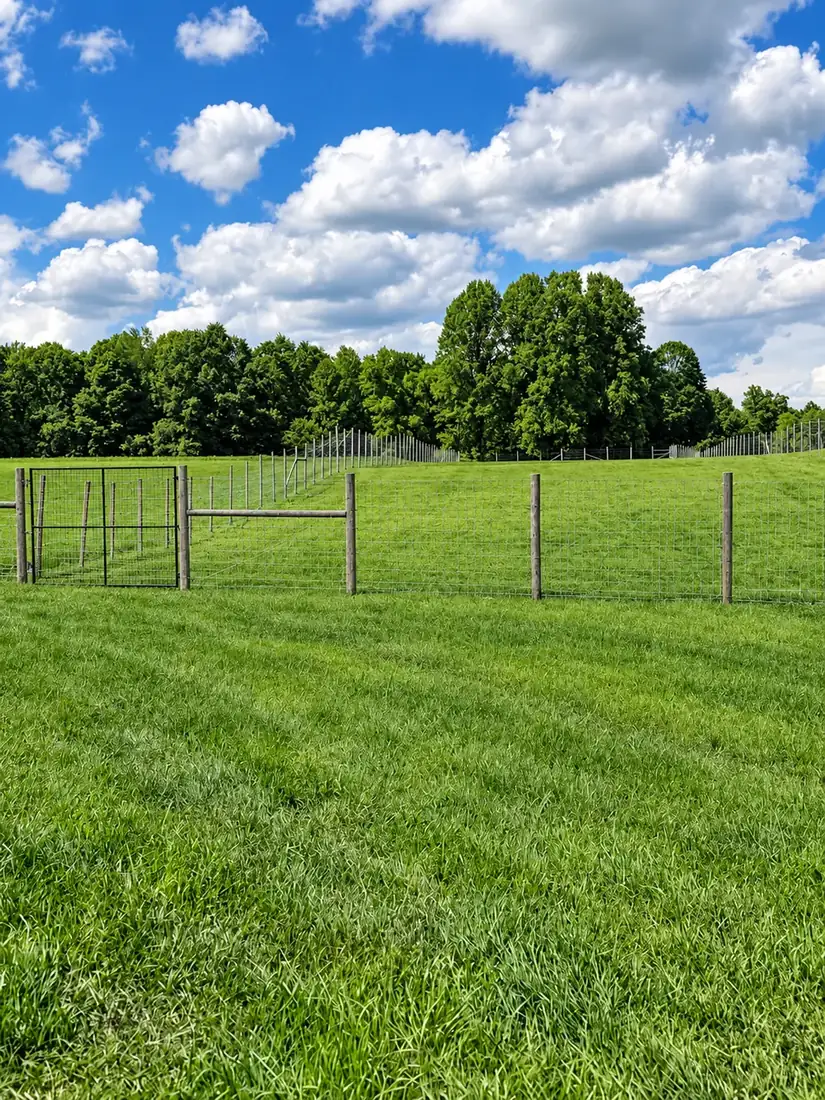
Who chain link suits
Chain link suits jobs where the fence has to be sturdy, see-through and straightforward. It marks a line, contains an area and lets you see what is happening on the other side. It does not hide anything, and it does not try to look like a board fence. Residential and farm uses overlap more than people expect.
| Use | Why chain link fits | What to plan for |
|---|---|---|
| Dog run or backyard | Open view, sturdy mesh, can be built tall | Gate latch, a clean top edge, and a plan for diggers |
| Equipment or storage yard | Secures an edge and stays plain | Heavy gate posts for a wide opening |
| Garden or small animal pen | Illinois Extension says chain link is good against predators | Mesh size and bottom edge matter more than height |
| Play area or court | Clear sightlines | Top rail height and a smooth top edge |
| Property line | Marks the line and holds it | Confirm the line first and check local height limits |
If privacy is the goal, see wood privacy fence. If you keep horses, read the caution further down before choosing chain link. Solid Rock Fencing builds chain link in Ohio and Pennsylvania from its base in Bristolville, and it is a locally owned, family owned company.
Gauge, mesh and coating
Three choices set the strength and the weather resistance of the mesh: wire gauge, mesh size and coating. The Chain Link Fence Manufacturers Institute, an industry trade group, lists fabric core wire in gauges 6, 9, 11 and 12. A lower number is thicker wire.
| Gauge | Wire diameter | Typical note |
|---|---|---|
| 6 | 0.192 inch | Heaviest of the four, used for heavy duty work |
| 9 | 0.148 inch | Michigan State University's standard core for its campus spec |
| 11 | 0.120 inch | Lighter wire, available with smaller mesh |
| 12 | 0.105 inch | Lightest of the four |
Two inch mesh is available in 6 and 9 gauge. Smaller meshes, 1 inch and under, are made in 9, 11 or lighter wire. Michigan State University's construction standard calls for 2 inch mesh in 9 gauge as standard and 6 gauge for heavy use. That is one campus project spec, so read it as a picture of a heavy-duty job and not a rule for every yard.
Coatings
The coating decides how the steel stands up to weather. The industry specification describes three families.
| Coating | Standard | What it is |
|---|---|---|
| Zinc coated | ASTM A392 | Class 1 carries 1.2 ounces of zinc per square foot, and Class 2 carries 2.0 ounces |
| Zinc and 5 percent aluminum | ASTM F1345 | A different metallic coating on the steel wire |
| Polymer coated | ASTM F668 | Class 1 extruded, Class 2a extruded and adhered, Class 2b fused and adhered |
Michigan State asks for a polymer coating under F668 Class 2b over zinc-coated steel. Color and coating are choices of look, budget and setting, and we go over them at the estimate. No neutral source we found gives a dependable lifespan for any coating, so be careful with anyone who quotes one.
Posts, top rail and tension wire
Good chain link starts with the frame, because the mesh can only hold if the posts do. The mesh is stretched tight across the line, and that tension pulls on the end, corner and gate posts every day. They are the posts to get right.
- Line posts at intervals not exceeding 10 feet on center, per the industry specification.
- Footings in Michigan State's spec are 4 feet deep for a 4 foot fence and 4.5 feet for a 6 foot fence; corner, gate and terminal posts sit in 12 inch diameter concrete at least 42 inches deep.
- Local frost depth is set by each jurisdiction and ran from about 30 to 42 inches in the Ohio and Pennsylvania documents we reviewed, so the number on your job can differ.
- Top rail is described at 1.660 inches outside diameter in 21 foot lengths, and fences 12 feet or higher call for a mid rail.
- Selvage is the finished edge of the mesh. Michigan State specifies twisted top and bottom selvage for fences 6 feet and taller and a knuckled top for fences 4 feet and under.
Tension wire is a wire run along the bottom of the fabric that holds the mesh down and straight between posts. We found no neutral source with dimensions for it, so we describe it in general terms. It matters on uneven ground and where dogs push at the bottom, and it is worth asking whether it is included in the quote.
Why corners and ends matter
The mesh pulls toward the nearest end or corner, so those posts carry the load of the whole run. Skimping on depth, concrete or bracing at a corner shows up first as a leaning post and a sagging line. University of Georgia Extension makes the same point about wire fence, where a corner or end may see about 3,000 pounds of pull when wire is first stretched. That figure is for farm wire fence and not for chain link, but the principle carries over.
Chain link gates
Gates are where chain link gets heavy, and a gate is only as good as its post. Michigan State's spec sizes swing gate posts by opening width, and calls for structural steel hinges, stops, drop rods and keepers, sized so the hinges do not twist and the gate stays level with the fence.
| Opening | Swing gate post, outside diameter |
|---|---|
| Under 13 feet | 4 inches |
| 13 to 18 feet | 6 5/8 inches |
| 19 to 20 feet | 8 5/8 inches |
That table is from a campus spec and not a law, but it shows the pattern: a wider gate needs a much bigger post. A walk gate and a drive gate are different jobs. Frost can push a gate post out of the ground, and the weight of the gate then tips it further, which is why a gate that drags often points to a post that has moved. See the gates page for walk gates, drive gates and farm gates.
Privacy slats, pets and pools
Slats, pets and pools each change what a chain link fence has to do, and each is worth a conversation at the estimate. Slats woven into the mesh give partial privacy, but they turn an open fence into a solid surface that catches wind the way a sail does. We found no neutral wind data for slatted fence, so we quote none. Ask about post size and spacing if you want slats, and check local height rules, since the fence now reads as a solid fence to a zoning officer.
- Dogs: ask how the bottom edge is held down, whether the top edge is knuckled or twisted, and how the gate latches. A dog that digs, jumps or chews uses different weak points.
- Children: a knuckled top edge and a latch out of reach are worth asking about.
- Pools: pool barriers are commonly required to be at least 48 inches high with a self-closing, self-latching gate. Confirm the exact rule, including whether chain link can be the barrier and how large the openings may be, with your local building department.
Local rules in Ohio and Pennsylvania
Height limits, permits and style rules for chain link are set locally, the same as for any other fence. In Ohio, the Residential Code of Ohio generally requires a building permit only for a fence over 6 feet, according to an Ohio permit guide. Front-yard fences are often limited to about 4 feet.
See fence permits and rules for who to call by county.
Repairing existing chain link
Many chain link problems can be repaired without replacing the fence, and Solid Rock Fencing does fence repair, which many fence companies do not offer. Illinois Extension notes that chain link sags over time, so walking the fence once a season catches problems early.
- A leaning post usually means the footing has moved or the corner is under-braced.
- Slack mesh means the fabric needs restretching or the end posts have shifted.
- Loose ties along the rail let the mesh sag and sound loud in the wind.
- Vines pulling on the top rail add weight and trap moisture.
- A gate that drags points to the hinge post, not the gate.
A repair holds only if the cause is fixed. Re-tying slack mesh on a post that is still leaning will not last. See fence repair for how we decide between repairing and replacing a section.
How the job goes from first call to finished fence
A chain link job runs from a phone call to a final walk along the line.
- Call for a FREE estimateCall (440) 241-4312 or use the FREE estimate page. Describe the area, the height and where gates should go.
- Walk the siteWe look at the ground, the corners, any slope and anything in the way, like trees or an old fence.
- Check the rulesHeight limits, permits and HOA rules are checked before work starts.
- Locate utilitiesThe digging crew calls 811 first: at least two working days ahead in Ohio and three business days in Pennsylvania. See call 811.
- Set posts and frameTerminal, corner and gate posts go in first, then line posts and rail.
- Hang the mesh and gatesThe fabric is stretched and tied, gates are hung, and the line is walked end to end.
Solid Rock Fencing offers a 10 year workmanship warranty with written terms in the estimate. It covers defects in workmanship, not weather, impact, animals or normal aging of materials.
Mistakes to avoid
Most chain link mistakes happen at the posts and the gate.
- Light wire on a heavy-use run, like a dog run or a gate line.
- Skimping on depth or concrete at corner, gate and terminal posts.
- Line posts spaced past 10 feet apart.
- Gate posts sized for a walk gate and then hung with a wide drive gate.
- Choosing a height before checking the local limit for front yards.
- Adding slats without checking post size or local rules.
- Planning chain link around horses without reading the horse fence guidance.
Get your FREE estimate
Tell us what you are fencing and where. We will talk it through with you and come out to walk the line.
Questions we hear
How far apart should chain link posts be?
The Chain Link Fence Manufacturers Institute specification sets line posts at no more than 10 feet apart, center to center. Corner, end and gate posts are larger and set deeper than line posts, because the mesh and the gates pull on them hardest.
What gauge chain link fence do I need?
Core wire comes in gauges 6, 9, 11 and 12, and a lower number is thicker. Michigan State's campus standard uses 9 gauge for standard work and 6 gauge for heavy use. The right choice depends on the use, so describe the job when you ask for an estimate.
Do I need a permit for a chain link fence?
Often not for a fence 6 feet or shorter, since the Residential Code of Ohio requires a building permit only above 6 feet, according to an Ohio permit guide. Cities, townships and HOAs set their own rules, so check locally. This is general information, not legal advice.
How deep do chain link posts go?
Michigan State's spec, one example, sets line posts 4 feet deep for a 4 foot fence and 4.5 feet for a 6 foot fence, with corner, gate and terminal posts in 12 inch concrete at least 42 inches deep. Local frost depth may change the answer on your site.
Is chain link a good fence for horses?
Usually not. Illinois Extension says chain link sags over time and costs more to maintain, and that chain link with sharp top wires should be avoided for horses. A board fence or V-mesh with a top rail is the better direction.
Can chain link be used around a swimming pool?
Maybe. Pool barriers are commonly required to be at least 48 inches high with a self-closing, self-latching gate, but the rules on mesh openings and what counts as a barrier vary by place. Ask your local building department before you buy, and check any pool permit requirement.
Can you repair a chain link fence you did not build?
Yes. Solid Rock Fencing does fence repair, including leaning posts, slack mesh and gates that drag. Call (440) 241-4312, describe what is wrong and how old the fence is, and we will set up a FREE estimate to look at it in person and tell you whether repair or replacement makes sense.
Does Solid Rock Fencing install chain link?
Yes. Solid Rock Fencing builds chain link in Ohio and Pennsylvania from its base in Bristolville. Call (440) 241-4312 or use the FREE estimate page and describe the area, the height you want, whether the fence is for dogs, equipment or a property line, and where any gates should go.
- CLFMI Product Manual, Section 32 31 13 chain link specification
- Michigan State University chain link fences and gates construction standard
- Illinois Extension, Safe fencing for horses
- University of Georgia Extension, Fences for the Farm (Circular 774)
- University of Missouri Extension G1193, fence costs
- Ohio fence permit guide (March 2026)
- City of Columbus fences form
- City of Columbus climatic and geographic design criteria
- City of Cleveland climatic and geographic design criteria
- Penn State Housing Research Center, soil freeze depth guide
- Poland Township zoning, fences and walls
- Pennsylvania Uniform Construction Code, Chapter 403
- Trumbull County Planning Commission, plats and zoning
- Violet Township, Ohio pool barrier requirements
- OHIO811 notification FAQ
- PA One Call, excavators