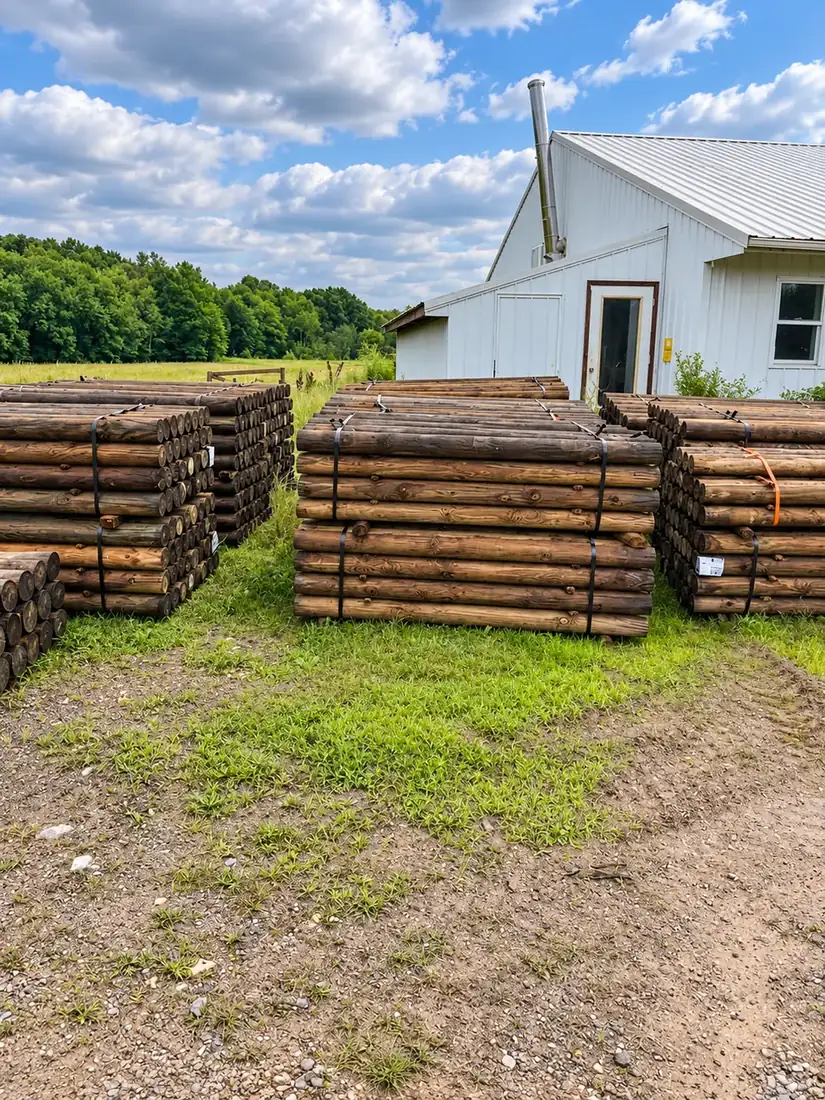
Every fence material has a job it does well and a way it lets you down. A board fence is easy for a horse to see. Woven wire holds sheep and goats if the stays are the right size. Chain link takes abuse but sags. This guide goes through posts, rails, wire, fasteners, gate hardware and finishes, so you can walk into a FREE estimate knowing what to ask for and what the answers should sound like.
The numbers come from university extension services, federal agencies and a few preservative and wire makers, and each source is listed at the bottom. They are ranges and guidelines. Your soil, your animals and your township change the answer. Solid Rock Fencing builds the fence types covered here in Ohio and Pennsylvania, and the owner states that the materials it uses are high quality and premium. What that word should mean is spelled out in our premium materials page.
Posts decide how long the fence stands
Most fences fail at the ground line, so the post, its treatment and the way it is set matter more than the rails or the wire. Decay fungi need moisture, oxygen and wood to feed on. The soil supplies the moisture, so rot concentrates right at grade, which is where a post is also under the most physical stress. In the long-term tests the Forest Service and Ohio's own experiment station published, the posts that failed failed from butt decay at or near the ground line.
Size and length
University of Georgia Extension lists wood fence posts as generally 5.5 to 8.5 feet long and 2.5 to 8 inches or more across. Corner and gate posts should be at least 8 inches across at the top, brace posts 5 inches or more, and dead-man end posts 10 to 12 inches, buried at least 4 feet. Line posts can be as small as 2.5 inches, though larger is stronger. Penn State adds that round posts are stronger than square posts of similar size.
Treated wood and what the tag says
The American Wood Protection Association sorts treated lumber into use categories. UC3B is for fence pickets and other uncoated parts above ground. UC4A is ground contact for ordinary exposure, which is where fence posts live. UC4B is for hard-to-replace parts and high-decay sites. UC4C is for critical structural use in severe conditions. In practice, premium ground-contact wood usually means UC4B, a higher stated retention, or a naturally durable species. Whether a supplier sells UC4B fence posts is a fair question to put to any contractor.
Two cautions. Lumber two inches or less thick may be treated for above-ground use only, so a thin treated rail that touches soil rots early. And wood treated to refusal should be avoided, along with unlabeled landscape timbers, which are often not treated for ground contact.
Naturally durable wood
Some species hold up without treatment, but only the heartwood. Black locust, osage orange and the cedars are the usual examples in Forest Service and Purdue material. Sapwood in the same tree lasts only a few years. Purdue notes that sapwood on a locust post deteriorated completely at the ground line. When you price posts of a rot-resistant species, ask how much sapwood is in each one.
Steel and plastic posts
Ohio's woven wire specification allows steel line posts at least 21 inches in the ground, and calls for steel where soil is under 28 inches deep. For horses, Penn State does not recommend metal or fiberglass T-posts because they pose a risk of impalement. Rigid PVC, recycled plastic and horse-safe steel posts are acceptable alternatives.
How the post is set matters as much as the post
A good post set badly will heave, lean or rot early, so setting method belongs in the quote. Depth guidance varies by source and by fence height. Penn State describes a typical line post at about 36 inches deep and corner and gate posts at about 48 inches. University of Wisconsin Extension says a 40 to 48 inch livestock fence ideally has posts buried 4 feet, generally below the frost line. Ohio NRCS sets wood line posts at no less than 30 inches.
On concrete versus tamped soil versus driven posts, the sources disagree, and that is worth knowing. Tennessee measured driven posts as 1.7 times as strong as tamped ones, and Penn State prefers driven posts for horse fence. Wisconsin says to tamp in layers and to use sand and gravel backfill in silt and clay, because freeze and thaw pushes dug posts out. The Forest Products Laboratory says to keep concrete at least 6 inches below the ground line so it does not hold water against the post, while a trade-press interview with a Forest Service researcher favors concrete that reduces movement and a sleeve that sits above grade and slopes away from the post. The setting method depends on soil, post and drainage, and a contractor who walks your line can say which fits.
Rails and boards
Board fence is the classic horse and pasture fence because animals can see it. Rails are usually nominal 1 by 6 or 2 by 6. Georgia Extension notes that 1 by 6 costs less but warps more and is weaker, which is why a rail that bows between posts is often the thin one. Illinois Extension describes a typical horse build as three to four horizontal hardwood planks, rough-cut 1 by 6, with the bottom board 10 to 12 inches off the ground.
Virginia Tech's older horse fencing article compares the usual boards. Rough-cut oak is hard, horses dislike chewing it, and it has high tensile strength, but unseasoned oak warps and rots faster at the post and board joint. Treated pine looks finished, resists rot and discourages chewing, but it needs thicker boards and the treatment wears over time. Georgia Extension adds that vinyl-coated wood and PVC need no painting but do need washing, and that vinyl-coated wood can still warp.
Treatment discourages chewing but may not stop it, and stressed or confined horses may chew anyway. An electric strand on the far side of the post keeps horses from rubbing or chewing a board. Penn State suggests one strand 4 to 6 inches above or just inside the top rail.
Wire, gauge and galvanizing
Wire covers distance cheaply, but the type has to suit the animal and the galvanizing has to suit the years you want from it. Gauge is a number where lower means thicker. Ohio NRCS specifies standard woven wire with top and bottom wires 10 gauge or heavier, intermediates and stays 14.5 gauge or heavier, and stays no more than 12 inches apart. Georgia Extension wants horse mesh at least 12.5 gauge unless it is high-tensile.
Galvanizing is the zinc coat. Class 1 is the lightest and Class 3 the heaviest, roughly two to three times as much zinc. Georgia Extension says Class 3 can easily add 5 to 10 years of life to fence wire in a humid climate like Georgia's. Red Brand, a wire maker, claims Class 3 lasts about 2.5 times as long as Class 1 and notes that commercial grade carries the least zinc and has no minimum standard. Those are manufacturer claims.
High-tensile smooth wire is 12.5 gauge in the Ohio specification, and Mississippi State puts non-electric high-tensile wire at 170,000 to 200,000 psi. It should be retensioned at least once or twice a year, and all the pull sits on the end and corner assemblies. Woven wire should be stretched only until the kinks flatten to about two-thirds of their original height. Field and woven wire fence covers stay spacing by animal, and horse fence covers why barbed wire is the wrong choice for horses.
Fasteners and hardware
Fasteners are small and cheap, and they are where a good fence quietly goes wrong. ACQ-treated wood is corrosive to metal. Wood-treatment industry guidance recommends hot-dipped galvanized or stainless steel nails, and screws rated for the preservative. Simpson Strong-Tie, a connector maker, recommends stainless steel where treated wood touches the ground, and says some treated wood carries more preservative than specification, in which case stainless, silicon bronze or copper is the safer choice. Georgia Extension says all fasteners should be galvanized, preferably Class 3, with grooved-shank nails or galvanized screws on boards.
Staples for wire should be 8 or 9 gauge, hot-dip galvanized, 1.75 to 2 inches long and never under 1.5 inches. Avoid driving them parallel to the grain, and let high-tensile wire slide so it can expand and contract. The Forest Products Laboratory warns that iron nails rust and stain wood.
Gate hardware
Hinges, stops, drop rods and keepers should be structural steel sized so the hinge does not twist. A gate drags when the post and bracing are too light, not because of the hinge alone, so Georgia Extension wants gate posts at least 8 inches across at the top. For horses, Penn State recommends tubular steel gates with no diagonal cross-bracing, because bracing can trap legs and heads, and gaps between gate and post should be closed up. See farm gates and drive gates.
Finishes protect the wood, and timing matters
A finish protects when it goes on dry wood, gets worked into the end grain and is renewed before it fails. The Forest Products Laboratory says paint blisters and peels when wood is above 20 percent moisture. Fresh treated lumber is wet. A preservative maker says it is typically ready to finish about 60 days after installation, depending on sun, weather and time since treatment, and a simple test is to see whether drops of water soak in. Kentucky Extension likewise says to let posts air-dry before painting.
End grain absorbs water faster than face grain, so finishes fail there first. Sealing ends and edges before assembly extends life. Rough-sawn lumber takes penetrating stain better than smooth planed wood. On rough cedar in the Forest Products Laboratory table, semitransparent stain is listed at 5 to 8 years against 3 to 5 for paint, while on smooth cedar paint is listed at 4 to 6 years. Purdue disagrees in emphasis and says film-forming acrylic paint protects most. Paint does best on smooth, primed wood, and stain is easier to keep up on rough boards because it fades instead of peeling. Those are test figures for similar wood, not promises for any fence. The full process is on our fence painting and staining page.
Materials side by side
The table is a starting point. Every row changes with the animal, the soil and the township.
| Material | Suits | Does well | Watch for |
|---|---|---|---|
| Treated wood post | Most farm and yard fence | Ground-contact rated posts handle wet soil | Cuts and thin lumber expose untreated wood |
| Rot-resistant heartwood post | Posts where treatment is not wanted | Heartwood resists decay | Sapwood fails within a few years |
| Steel T-post | Wire pasture line, shallow soil | Allowed to 21 inch depth in Ohio spec | Impalement risk with horses |
| Board and rail | Horses, visible boundaries | Animals see it | Warp, rot at the joint, upkeep |
| Woven wire | Cattle, sheep, goats | Holds mixed stock | Stay spacing, corner bracing |
| High-tensile wire | Long pasture runs | Few posts, strong strands | Heavy end assemblies, yearly retension |
| Barbed wire | Cattle only | Holds cattle well | Unsafe for horses, never electrify |
| Chain link | Yards, kennels | Tough against predators | Sags over time, coating and gauge |
What fails first, and how to spot it
Knowing the usual failure order tells you where the money in a quote should go. The table lists the parts that give out first, what the owner usually notices and what a repair has to address.
| Part | How it fails | What you notice | What a fix must address |
|---|---|---|---|
| Wood post at grade | Decay where moisture meets air | Post wobbles or snaps at the ground | Replace with ground-contact post, proper setting |
| Corner or end assembly | Pull exceeds anchor and brace | Wire goes slack down the whole line | Rebuild brace assembly, then retension |
| Gate hinge post | Soil movement, gate weight | Gate drags or will not latch | Larger post, diagonal brace, level hinges |
| Thin rails | Warping under load | Bowed boards between posts | Move to heavier rail, correct fasteners |
| Plain steel fasteners | Corrosion in treated wood | Rust streaks, loose boards | Hot-dip galvanized or stainless |
| Wire | Stretch, rust, kinks | Sag, rust, gaps at the bottom | Retension or replace |
| Finish on end grain | Moisture enters first | Peeling at rail ends | Clean, dry, re-coat, seal ends |
A fence with several of these at once is often a rebuild, not a repair. That is a judgment call, and the answer comes from walking the line. Fence repair explains what can be saved.
Mistakes that cost money later
- Using lumber rated for above ground in the soil, or thin treated rails that touch the ground.
- Putting barbed wire on a line that will hold horses, or electrifying barbed wire anywhere.
- Choosing wire stays that trap a head, or a horn on a goat.
- Building a wire fence with corner assemblies that are too light, so the line goes slack within a season.
- Painting or staining wet treated wood, then wondering why the finish blisters.
- Skipping the call to 811. See call 811 before you dig.
Questions to ask before you buy
Specific questions get specific answers, and a contractor who knows the work answers them without fuss. Take these to any estimate.
- What use category and retention is on the tag, and is it UC4A or UC4B?
- Is the post heartwood, or does it include sapwood?
- Are the posts and rails dry, and how long since treatment?
- What fasteners and staples go in, and are they hot-dip galvanized or stainless?
- What wire class and gauge is quoted?
- How deep are the posts, how are the corners braced and how is the ground-line cut end protected?
- What hardware goes on the gates, and is the gate post sized for the gate?
Get your FREE estimate
Tell us what you are fencing and where. We will talk it through with you and come out to walk the line.
Questions we hear
What is the best fence post for Ohio and Pennsylvania soil?
A post rated for ground contact, at UC4A or higher, or heartwood of a naturally durable species, set deep enough and braced where wire pulls. The material matters, but the setting and drainage matter just as much. A contractor should walk your soil before naming a post and a method.
How do I read a treated post tag?
Look for AWPA U1, the use category such as UC4A or UC4B, the preservative name, the retention in pounds per cubic foot, and the manufacturer. Without AWPA U1 and a use category, the wood probably does not meet the standard. Avoid wood treated to refusal and unlabeled landscape timbers.
Is galvanized wire worth the extra money?
Heavier zinc coats protect longer. Georgia Extension says Class 3 galvanizing can add 5 to 10 years in a humid climate, and wire makers claim similar gains. Those are published claims, not guarantees. Ask which class is quoted, since commercial grade has the least zinc and no minimum standard.
Can I paint or stain a new treated fence right away?
Not usually. Fresh treated wood is wet, and paint blisters above 20 percent moisture. A preservative maker says about 60 days after installation is typical, and a water drop that soaks in is the test. Weather and sun change the time, so check the wood before booking a finishing crew.
What fasteners should go into treated wood?
Wood-treatment guidance recommends hot-dip galvanized or stainless steel nails, and screws rated for the preservative. Stainless is the safer choice where treated wood touches the ground. Plain iron nails rust and stain the boards, so ask what the quote includes.
Which fence materials are unsafe for horses?
Extension sources say never use barbed wire for horses, and caution about wide-spaced woven wire and metal T-posts. Penn State also recommends tubular steel gates without diagonal bracing. Visible rails or boards are the usual choice, with an electric strand added if horses lean or chew.
Do you build with premium materials?
The owner of Solid Rock Fencing states that the materials are high quality and premium. Because that word has no fixed meaning, ask for the use category, retention, wire class and fasteners in writing during the FREE estimate. Call (440) 241-4312.
- Penn State Extension, Fence Planning for Horses
- UGA Extension Bulletin 1192, Fences for Horses
- UGA Extension Circular 774, Fences for the Farm
- Illinois Extension, Safe Fencing for Horses
- University of Tennessee Extension PB1541
- Ohio NRCS woven wire fence specification (August 2016)
- University of Wisconsin Extension, Setting Fence Posts
- USDA Forest Products Laboratory, Protecting Wood Fences for Yard and Garden (1979)
- USDA Forest Products Laboratory, Finishing of Wood (AH-647)
- Purdue Extension NCR-132, Exterior Wood Finishing
- Purdue Extension FNR-277-W, Black Locust
- American Wood Protection Association, homeowner information
- USDA Forest Service, Treated Wood guide
- Journal of Light Construction, Protecting Fence Posts from Rot
- Viance, Staining Decks and Fences
- Simpson Strong-Tie, wood connectors and fasteners corrosion guidance
- Design World, fasteners for pressure treated wood
- Red Brand, wire galvanization
- Virginia Tech Extension, horse fencing (1999)
- Mississippi State Extension, Livestock Fencing Systems for Pasture Management
- Langston University, goat fencing
- HorseDVM, lead poisoning
- University of Kentucky Extension, FORFS 03-05, Fence Posts
- Grainews, tips to prevent and fix a sagging livestock gate (2016)
- City of Columbus, climatic and geographic design (CIC 09)
- City of Cleveland, climatic and geographic design criteria
- Penn State Housing Research Center, Soil Freeze Depth Guide