Who farm and ranch fence suits
Farm and ranch fence suits anyone who has to hold animals in and keep road traffic, neighbors' stock and wildlife out. That covers a cattle operation with a long road frontage, a hobby farm with six sheep, a goat pen that gets tested every day, and a horse paddock beside the barn. The animals come first, because a fence that holds steers can fail on goats and can hurt a horse.
Solid Rock Fencing builds farm and ranch fence in Ohio and Pennsylvania from our base in Bristolville. If your animals are horses, read the horse fence page as well, since horses need different rules for height, visibility and openings. If most of your run is mesh, the field and woven wire page goes deeper on stays, gauge and stretching.
- Cattle on pasture that needs a tight perimeter and a few good working gates.
- Goats and sheep, where the openings in the fence matter as much as the height.
- Barn lots, lanes and loading areas where a gate is opened and shut every day.
- Road frontage, where a failed fence turns into a traffic problem.
- Cross fences that split one field into rotation paddocks.
What each kind of livestock needs from a fence
Each animal tests a fence in a different way, so the animal list decides the build. Cattle lean and push, sheep look for gaps at the bottom, goats climb and put their heads through, and horses run into what they cannot see. The numbers below come from university extension and USDA NRCS documents. They are planning guides, not a promise for any one farm.
| Animal | What the sources say | What it means for the build |
|---|---|---|
| Cattle | University of Tennessee gives a 54 inch minimum for perimeter cattle fence and at least 60 inches around handling facilities. Ohio NRCS gives 48 inches minimum total height for cattle. | Tall enough that a steer cannot step over, with the strongest build around working pens and chutes. |
| Sheep | Ohio NRCS gives 42 inches minimum. University of Tennessee notes that barbs collect wool. | Mesh or tight-spaced strands low down, and no barbed wire where wool will snag. |
| Goats | Langston University says a 48 inch fence will contain goats except under extreme circumstances. Oklahoma State says standard barbed wire is poor for goats. | Woven wire with stays that stop heads going through, and no reliance on barbed wire. |
| Horses | Penn State gives 54 to 60 inches, with openings held to 12 inches or less. Penn State and Illinois Extension both say barbed wire is unsafe for horses. | Visible rails or boards, no sharp wire, and the horse fence page for the details. |
| Swine | Ohio NRCS gives 36 inches minimum total height. | A tight, low bottom, since hogs root and push. |
Board, woven wire or high tensile
Board fence gives the most visible, forgiving line, woven wire gives the tightest hold on small animals, and high tensile covers the longest runs with the fewest posts. Most farms end up with a mix, with board along the road and by the barn and wire on the back fields. Here is how they compare in the extension guides.
| Style | Where it fits | Things to watch |
|---|---|---|
| Board or rail | Road frontage, barn lots, horse areas, lanes. University of Tennessee says board heights of 4 to 5 feet are most common for livestock, with posts about 8 feet apart. | More posts and more lumber per foot, and a cow rubbing on a rail tests every joint. Wood needs finish upkeep. |
| Woven wire | Mixed stock, sheep, goats and long perimeters. Ohio NRCS allows line posts up to 16 feet apart for standard woven wire. | Standard woven wire runs shorter than the 54 inch cattle minimum, so a top strand or board is often added. Needs strong ends. |
| High tensile | Large pastures and cross fences. University of Tennessee lists 40 to 60 feet between posts. | All the tension rides on the ends and corners, so brace assemblies cannot be skimped. Wire needs retensioning. |
| Barbed wire | Cattle only. Oklahoma State says 3 to 5 strands hold cattle well. | Poor for goats and sheep, unsafe for horses, and some residential zoning bans it. |
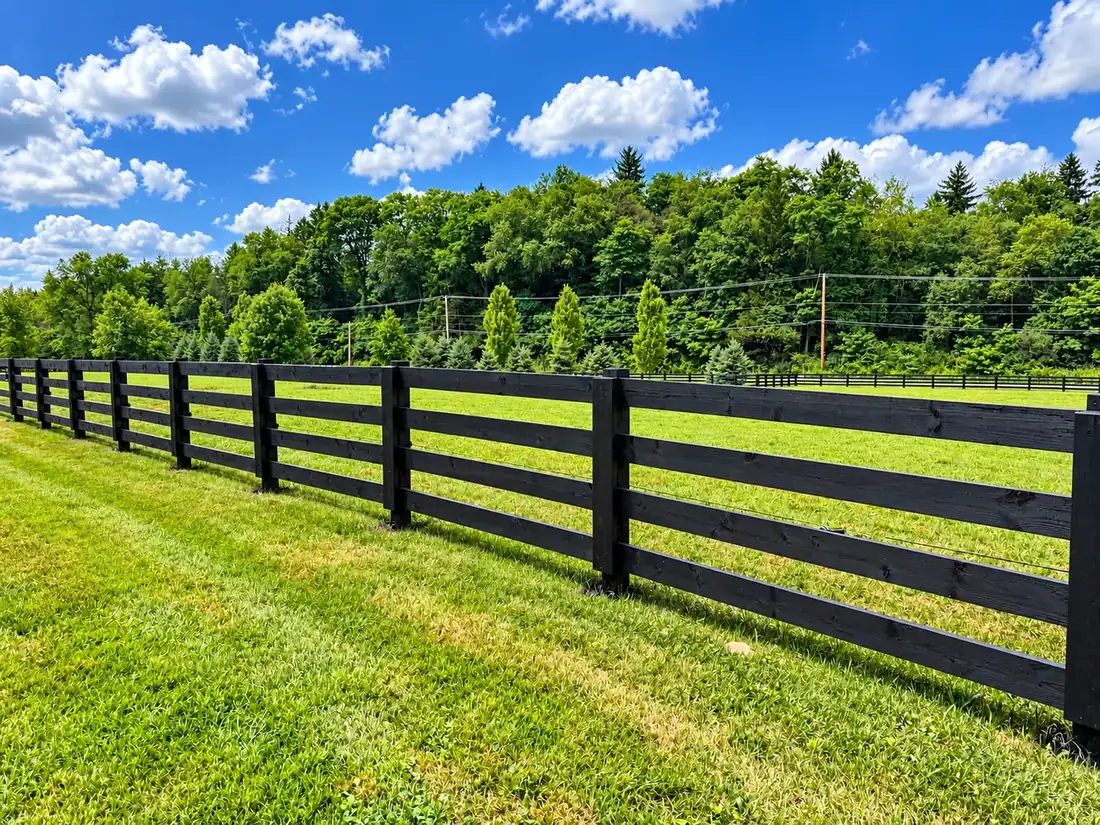
The black four-board fence in our job photos shows board fence at its best. It is a tall, visible rail line on heavy posts, and in the pasture photos it holds cattle while still looking like a finished farm. If you want that look, ask about the finish at the start and read our fence painting and staining page for how wood finishes behave.
Ohio partition fence rules
Ohio law has its own definition of a shared property line fence, and it matters before you build along a neighbor's boundary. Ohio Revised Code 971.01 defines a partition fence as a boundary fence between two owners. It defines a preferred partition fence for livestock as woven wire, standard or high tensile, with one or two barbed wire strands at least 48 inches above ground, or a nonelectric high tensile fence with at least seven strands. Either one is built to the USDA NRCS fence standard, code 382.
- Barbed wire, electric or live fences can also count if the adjoining owners agree in writing.
- Unless a written agreement applies, each owner pays half to build and maintain a shared partition fence under ORC 971.071.
- An owner who builds better than the preferred standard pays the extra cost, under ORC 971.02.
- If a neighbor will not build or maintain a share, township trustees can hear the complaint under ORC 971.09, with at least 10 days' written notice to the owners.
- A person building a partition fence, or a hired contractor, may go onto the neighbor's land up to 10 feet from the boundary and answers for any damage, under ORC 971.08.
Ohio also expects keepers to contain livestock. ORC 951.02 says owners may not let animals run at large on a public road or on unenclosed land, and ORC 971.18 makes an owner who negligently lets stock out liable for damage they cause.
Corner and brace assemblies carry the whole fence
Wire fence is only as good as its corners, because the wire pulls on them every hour of the day. The University of Georgia says a corner or end can see about 3,000 pounds of pull when wire is first stretched, rising to about 4,500 pounds in winter cold. Each fence line leading to a corner needs its own brace assembly.
An H-brace is the standard answer. A second post sits about 8 to 10 feet down the line from the end post, joined by a horizontal cross member, and a diagonal wire ties the two into one rigid unit. University of Wisconsin Extension says the brace post can be slightly smaller than the end post but must be set just as deep. Ohio NRCS asks for braces at all corners, gates, pulls and ends, and allows no more than 660 feet between pull assemblies on standard woven wire, or 1,320 feet on high tensile woven wire.
Posts, spacing and depth
Line posts hold the wire up and corner posts hold it tight, so they are sized and spaced differently. University of Tennessee lists post spacing of 14 to 16 feet for woven wire, 12 to 14 feet for barbed wire, 40 to 60 feet for high tensile and about 8 feet for board fence. Curves need closer posts, and Massachusetts NRCS tightens spacing as the bend gets sharper.
For depth, many guides call for roughly 3 to 4 feet for livestock line posts and more for corners and gates. Ohio NRCS wants wood line posts at least 30 inches below ground. Frost depth is set locally, and the code documents we found for Columbus, Cleveland and Pennsylvania townships run from about 30 to 42 inches. Your township or building office sets the number for your site.
Ground-contact wood has to be rated for ground contact. The American Wood Protection Association calls for Use Category 4A or higher for posts, and the Forest Products Laboratory says lumber marked for above ground use only should not go in the soil. Penn State puts the life of a pressure-treated post at 10 to 25 years, and Kentucky Extension gives 20 to 35 years for properly treated and installed pine. Those are research ranges, not a promise on any fence we build.
Gates for equipment, stock and people
Put gates where the animals and the tractor need to go, and size them for the biggest machine that will ever come through. UGA suggests pasture gates for tractors and mowers be 14 to 16 feet wide, and Penn State puts the maximum gate width at 16 feet. A gate that is too narrow for the mower becomes a gap people take down.
- Place gates in the corners of paddocks, so animals can be pushed into them without a dead end.
- Avoid low spots where water stands, since a gate post in wet ground rots early.
- Leave a walk gate beside any large gate for feeding and checking stock.
- Match gate height to fence height, as Penn State advises.
The gates page covers widths, hinge posts, latches and sag in full, and the fence repair page covers fixing a gate that already drags.
Pasture layout, lanes and cross fences
A good layout cuts both the length of fence and the trips with the tractor. A straight continuous run is the cheapest to build, and every extra corner, gate and brace adds time and expense, according to University of Missouri Extension. That makes layout a cost decision as much as a grazing decision.
- Draw what you haveList each field, water source, barn, shade tree and existing fence, with the animals that use each.
- Decide the lanesA lane from the barn to each field lets you move stock without opening every gate.
- Place the gatesSet them where lanes meet fields and where machines enter.
- Count the cornersEach braced corner is both a cost and a strong point, so plan them on purpose.
- Set the order of workBuild the perimeter first, then add the cross fences you can phase in later.
What a real farm walk-through covers
A real walk-through covers the whole property and not only the fence line, because gates, water and animal habits change the answer. It is the part of the FREE estimate that matters most. The how estimates work page explains the process from first call to finished fence.
- Which animals are on each side of each fence, now and in the future.
- Where the existing fence stands, what can be reused and what has to come out.
- Corner and end locations, and the soil and slope at each one.
- Gate positions, widths and the equipment that must get through.
- Wet ground, rock, trees, ditches and utility lines. Ohio requires a call to OHIO811 before digging, and Pennsylvania uses PA One Call at 811.
See our call 811 page for the notice periods that apply.
Mistakes to avoid
- Building the line before bracing the ends. Tightening wire against a weak corner pulls it over, and the fence goes slack within a season.
- Choosing barbed wire for goats, sheep or horses because it was cheaper. Penn State says for horses the savings are often lost to veterinary bills.
- Using lumber rated for above-ground use only as posts. It rots at the soil line early.
- Running concrete up to the surface. The Forest Products Laboratory says concrete that reaches the surface traps water against the post, and suggests keeping it at least 6 inches below ground line.
Maintenance that keeps a farm fence working
A fence needs a walk at least twice a year and after every storm. UGA says to retension high tensile wire at least once a year, and in another place says once or twice. Because corner pull rises in winter cold, a spring walk to check wire tension and the braces is our own advice and not a quoted rule.
- Check corners, gate posts and braces for lean or movement.
- Look for wire that is slack, kinked, rusty or stretched.
- Look at the soil line on wood posts for soft spots.
- Check latches and hinges, and oil what moves.
When something fails, the fence repair service is built for that. Many fence companies only build new fence, and Solid Rock Fencing also repairs.
What affects the price of a farm fence
The warranty is a separate matter. Solid Rock Fencing offers a 10 year workmanship warranty, with written terms provided with the estimate. It covers defects in workmanship, not weather, impact, animals or normal wood aging. Read the warranty page before you decide.
Get your FREE estimate
Tell us what you are fencing and where. We will talk it through with you and come out to walk the line.
Questions we hear
What is the best fence for cattle?
It depends on the pasture. Board or rail fence gives a visible line, woven wire with a top strand holds mixed stock, and high tensile suits long runs. University of Tennessee gives a 54 inch minimum for perimeter cattle fence, and Ohio NRCS gives 48 inches. Strong corners matter more than which style you pick.
What is a preferred partition fence in Ohio?
Under ORC 971.01 it is woven wire, standard or high tensile, with one or two barbed wire strands at least 48 inches above ground, or a nonelectric high tensile fence with at least seven strands, built to the NRCS standard. Neighbors can agree in writing to a different fence. Check with your township and an attorney.
Who pays for a fence between two farms in Ohio?
Unless a written agreement applies, ORC 971.071 splits the cost of building and maintaining a shared partition fence equally between the two owners. Existing fences, new fences and disputes follow other sections. Rules vary by township, so check with the township office. This is general information, not legal advice.
Can one fence hold cattle and goats?
It can, if you build for the goats. Woven wire with stays that stop heads going through works better for goats than barbed wire, and Oklahoma State calls standard barbed wire poor for goats. We size it on the walk-through.
How far apart should farm fence posts be?
It depends on the fence type. University of Tennessee lists about 8 feet for board, 14 to 16 feet for woven wire, 12 to 14 feet for barbed wire and 40 to 60 feet for high tensile. Curves and rough ground need posts closer together. We set spacing after seeing your land.
Do I need a permit for a farm fence?
Often not, but it depends where you are. Ohio township zoning generally cannot stop farm use under ORC 519.21, though that section does not name fences. Pennsylvania zoning is by municipality. Rules vary by township and municipality, so call your local zoning office before building. This is general information, not legal advice.
Do you repair old farm fence as well as build new?
Yes. Many fence companies only build new fence, and Solid Rock Fencing also repairs fence, including leaning posts, slack wire and sagging gates. Sometimes fixing the corners and restretching the wire is the sensible answer, and the walk-through will say which. Call (440) 241-4312 for a FREE estimate.
- University of Tennessee Extension, Fencing for Livestock (PB1541)
- USDA NRCS Ohio, Woven Wire Fence specification (2016)
- University of Georgia Extension, Fences for the Farm (Circular 774)
- Penn State Extension, Fence Planning for Horses
- University of Wisconsin Extension, bracing fence ends and corners
- Oklahoma State Extension, Meat Goat Production, fencing chapter
- Langston University, goat fencing
- Kentucky Extension, fence posts (FORFS 03-05)
- University of Missouri Extension, G1193
- Ohio Revised Code 971.01
- Ohio Revised Code 971.02
- Ohio Revised Code 971.071
- Ohio Revised Code 971.08
- Ohio Revised Code 971.09
- Ohio Revised Code 971.18
- Ohio Revised Code 951.02
- Ohio Revised Code 519.21
- Pennsylvania Farm Bureau, Boundary and Fencing Laws
- USDA Forest Products Laboratory, Protecting Wood Fences (1979)
- American Wood Protection Association, residential use categories
- USDA NRCS Massachusetts, Fence standard 382 (2011)
- City of Columbus, climatic design (frost depth)
- City of Cleveland, climatic and geographic design
- Illinois Extension, Safe Fencing for Horses
- OHIO811 homeowner page
- Pennsylvania One Call, FAQs for homeowners
- University of Georgia Extension, Fences for Horses (Bulletin 1192)