Who horse fence suits
Horse fence suits anyone who turns a horse out and wants it to stay in without getting hurt. That means a backyard paddock with one gelding, a boarding barn with several fields, a breeding farm with mares and foals, and a trail rider with a few acres behind the house. A horse is a large, fast animal that panics, and the fence has to be built for the worst second of the day, not the average one.
Solid Rock Fencing builds horse fence in Ohio and Pennsylvania from Bristolville. This page covers safety, the common styles, finishes, gates and turnout layout. For cattle, sheep and goats see the farm and ranch fence page, and for wire detail see the field and woven wire page.
What makes a fence safe for horses
A safe horse fence is tall enough, easy to see, clear of snag points and built so a leg or head cannot get caught. Every university guide we read lands on the same four ideas, and they are the checklist to hold any builder to.
- Height. Penn State says horse fences should be 54 to 60 inches above ground, with the top at wither height for the horse, and larger horses, stallions and good jumpers may need taller. UGA says perimeter fence should be at least 5 feet.
- Visibility. Penn State says horses are far-sighted, so a fence has to be visible even up close, and wire is the least visible. Boards or rails read as solid to a horse.
- Openings. Penn State says to keep the open space between rails or strands at 12 inches or less, and to make openings either too small for a hoof to pass or large enough that a foot, leg or head cannot be trapped.
- No snag points. Sharp ends, loose wire, protruding bolts and barbs are where horses tear skin.
| Question | What the sources say | What it means for you |
|---|---|---|
| How tall? | Penn State gives 54 to 60 inches. UGA gives at least 5 feet for a perimeter and 4.5 feet for pasture dividers. Illinois Extension gives 5 feet for most light breeds and 6 feet for taller breeds or known jumpers. | Tell the builder the breed, the size and whether the horse has ever tried to jump. |
| How low can the bottom rail go? | Penn State says about 8 inches of clearance avoids trapping a hoof, and that the bottom rail should be no higher than 12 inches so foals cannot roll under. Illinois Extension says the bottom board should sit 10 to 12 inches above ground. | If you will have foals, say so before the layout is drawn. |
| How wide can the gaps be? | Penn State says 12 inches or less between rails or strands, with electric fence allowed up to 18 inches because horses avoid touching it. | Gaps are measured at the widest point, including near gates and posts. |
Board, rail and woven wire compared
Board and rail fence is the traditional choice, and mesh wire with a top rail is the practical one for small paddocks and foals. Each works when it is built to the safety list above, and each fails in its own way when it is not.
| Style | Strengths | Watch for |
|---|---|---|
| Board or rail | Highly visible and looks solid to a horse, according to UGA. University of Tennessee gives post spacing of 8 to 10 feet for board fence, with boards 1 to 2 inches thick and 4 to 6 inches wide. Illinois Extension describes 3 to 4 horizontal hardwood planks, rough-cut 1 by 6. | Chewing and rubbing, and a lot of lumber and fasteners to keep sound. Rails need a finish. |
| Woven wire with a 2 by 4 inch pattern | Illinois Extension calls V-mesh the safest wire option. UGA says diamond mesh and square-knot mesh have 2 by 4 inch openings small enough to keep hooves from getting caught, with no exposed sharp ends. | Wire alone is hard to see, so add a top board or sight rail. UGA says mesh should be at least 12.5 gauge unless it is high tensile steel. |
| Electric tape | UGA says tape is about 1.5 inches wide and is easier to see than thin wire. Penn State says one strand 4 to 6 inches above or just inside the top rail deters horses that lean or reach over. | Illinois Extension says electric wire is not suitable as the sole perimeter fence. Horses must be contained safely when the current is off. |
| High tensile wire | Long, quiet fence lines on larger acreage. | Virginia Tech says it can cause serious injury if horses run into it, should be electrified, and should not house young horses. University of Tennessee notes entanglement risk. |
You will see the name no-climb on some wire products. That is a manufacturer's term. The extension guides describe the same idea as square-knot or V-mesh with 2 by 4 inch openings, and that is the pattern to ask about by size.
Penn State also says that diagonal bracing at wire corners can create entrapment spaces, and that rounded corners are highly recommended for wire horse fence. Illinois Extension warns that woven wire with a wider weave can trap the hoof of a pony or small foal. Welded wire with 2 by 4 inch openings is not recommended by UGA because its joints fail under field conditions.
Posts, depth and bracing for horse fence
Wood posts set deep and driven or well tamped give a horse fence its footing. Penn State recommends wood for all horse fence posts and says metal and fiberglass T-posts are not recommended because they pose a serious risk of impalement.
- Line posts are typically 36 inches deep, and corner and gate posts are about 25 percent larger and set about 48 inches deep, according to Penn State.
- UGA says rail or plank fence posts go 8 to 10 feet apart, and wire fence line posts 10 to 12 feet apart.
- Round posts are stronger than square posts of similar size, per Penn State. A pressure-treated post can last 10 to 25 years, which is a research range and not a promise on any fence we build.
- Ground-contact posts need ground-contact treatment. The American Wood Protection Association calls for Use Category 4A or higher.
- Penn State recommends driven posts over hand-set posts for horse fence, and hollow posts need top caps.
Painting or staining a black board fence
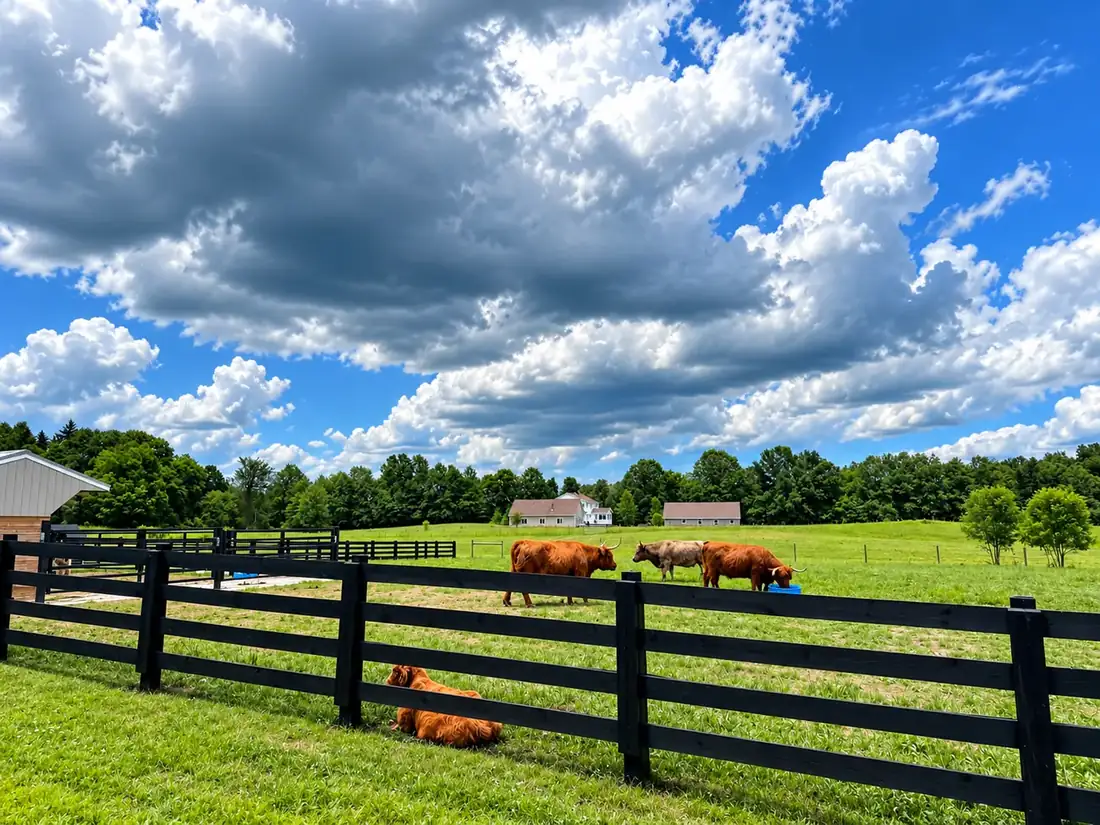
A black board fence is a finish on top of wood, and the finish decides how the fence looks after the second year. Our job photos include black fence around pastures, and the look is popular on horse farms. Our fence painting and staining service covers paint and stain on new and old fence.
- Let new treated lumber dry first. Viance, a preservative maker, says treated wood is typically ready for finishing about 60 days after installation, and a water drop test shows when it is dry enough.
- Seal the end grain. The Forest Products Laboratory says finishes usually fail first at end grain.
- Ask the product maker whether the finish is safe for livestock contact, and keep horses off until it has fully cured. We do not know of a veterinary source that settles this for modern products, so the label and maker are the answer.
- Old painted rails need care. Paint made before 1977 often contained lead, and horses can be exposed by chewing painted wood, per HorseDVM.
- Add an offset electric strand if a horse chews or rubs the boards. UGA suggests this.
Gates and latches horses cannot open
A horse gate needs to be wide enough to lead a horse through without a squeeze, as tall as the fence, and fitted so nothing can trap a hoof or a head. Penn State puts handler gates at 4 feet minimum with 5 feet preferred, and vehicle and tractor gates at 12 feet or more. UGA says any gate a horse passes through should be at least 4 feet, and at least 8 feet if equipment may pass.
- Penn State recommends horse-safe tubular steel gates, often 1 3/8 inch pipe, and says to avoid diagonal cross bracing on gates because it can trap legs and heads.
- UGA says to avoid gaps between gates and supporting posts, where hooves or foal heads can get caught.
- Choose a latch that takes a deliberate two-step motion. Horses learn to lift and nudge simple slide bolts, and we do not know of a study on latch types, so this is practical advice, not a sourced rule.
The gates page covers hinge posts, sag and hardware in more depth, and the gates and posts article shows how we think about the post a gate hangs on.
Foaling paddocks and small turnouts
Small paddocks and foaling areas call for the safest fence on the farm, because a foal can get through openings an adult cannot. Penn State says the bottom rail should be no higher than 12 inches so foals cannot roll under. UGA says paddocks under 2 acres, corrals and stallion pens should have the top about at the horse's head height, usually 4 to 6 inches above the withers.
- Mesh with a 2 by 4 inch pattern and a top rail suits foals better than wide-spaced rails. Virginia Tech says woven wire in small paddocks should be V-mesh with a top rail.
- Round the corners of wire paddocks so no horse is pinned.
- Keep the foaling area gate on solid, level ground, and keep the latch out of reach.
- Avoid chain link with sharp top wires. Illinois Extension says to avoid it for horses, and notes it sags over time.
Turnout layout and lanes
Good turnout layout gives horses room to move and handlers a safe way to bring them in. UGA says pasture dividers can be 4.5 feet, with the bottom 6 to 8 inches above ground, while perimeter fence should be at least 5 feet.
- Mark the barn and the waterEverything else radiates from where the horses start and end the day.
- Draw the lanesA lane from the barn to each paddock lets you move horses without crossing another field.
- Place the gates in the cornersRounded corners and gates set at the side of a paddock let a handler turn a horse without trapping it.
- Choose heights by fieldPerimeter fence goes up to the tallest height you need, and dividers can be shorter.
- Plan for growthIf a second paddock is likely, set a corner post now that can take the future fence.
The how estimates work page explains what to expect on the walk-through.
What to ask a horse fence builder
| Ask | Why it matters | A good answer sounds like |
|---|---|---|
| What height for my horses? | Penn State, UGA and Illinois Extension all vary by breed and use. | A number tied to your horses, not a standard height for everyone. |
| How wide are the gaps? | Entrapment is the injury risk. | Gaps under about 12 inches, measured at gates and posts too. |
| What posts, how deep? | Soil and frost vary. | Wood posts, set to a stated depth, with larger corner and gate posts. |
| What wire, and how is it seen? | Wire is hard for horses to see. | A 2 by 4 inch mesh with a top board or rail, and rounded corners. |
| What about the finish? | Stain and paint affect how the fence ages and what horses lick. | A named plan, with cure time before turnout. |
| What is under the warranty? | A warranty only helps if the terms are clear. | Written terms covering workmanship, given with the estimate. |
Mistakes that injure horses
- Putting up barbed wire or leaving old barbed wire in place inside a horse field.
- Using metal T-posts without caps or guards where horses run.
- Leaving a gap between the gate and its post that a hoof or a foal's head can enter.
- Building to a height that suits a pony when a horse lives there.
- Using a gate with diagonal cross bracing, which can trap legs and heads.
- Setting a bottom rail too low or too high, so a hoof catches or a foal rolls under.
- Choosing electric tape as the only perimeter and counting on it staying on.
What affects the price of a horse fence
Solid Rock Fencing offers a 10 year workmanship warranty, with written terms provided with the estimate. It covers workmanship defects, not weather, impact, animals or normal wood aging. See the warranty page for how it is described.
Get your FREE estimate
Tell us what you are fencing and where. We will talk it through with you and come out to walk the line.
Questions we hear
How tall should a horse fence be?
Penn State says 54 to 60 inches, with the top at wither height, and more for large horses, stallions and jumpers. UGA says at least 5 feet for a perimeter and 4.5 feet for dividers. Illinois Extension says 6 feet for taller breeds or known jumpers. Tell us the breed and we size it.
Is woven wire safe for horses?
Only the right kind, and only with a top rail. Illinois Extension calls V-mesh the safest wire option, and UGA describes 2 by 4 inch mesh as small enough to keep hooves from getting caught. Wide-spaced woven wire is less safe because it can trap a pony or foal hoof. Barbed wire should never be used.
What is no-climb horse fence?
No-climb is a manufacturer's name for woven wire with small openings. Extension guides describe the same idea as square-knot or V-mesh with 2 by 4 inch openings. Ask a builder for the opening size and the wire gauge rather than the brand name. UGA says mesh should be at least 12.5 gauge.
Can you paint or stain a black horse fence?
Yes, we paint and stain fence as well as build it, and many fence companies do not offer that. Treated wood should dry first, and the finish should be safe for livestock contact and fully cured before turnout. Ask the product maker. See our painting and staining page.
How far apart should horse fence posts be?
University of Tennessee gives 8 to 10 feet for board fence, and UGA gives 8 to 10 feet for rail or plank fence and 10 to 12 feet for wire. High tensile can run much wider. Corner and gate posts are larger and deeper. We set spacing after we walk your land.
Is electric fence good for horses?
As an addition, yes. Penn State says one electric strand 4 to 6 inches above or just inside the top rail deters leaning and reaching. Illinois Extension says electric wire is not suitable as the sole perimeter fence. Horses must be safely contained when the current is off.
Do you build horse fence in Pennsylvania as well as Ohio?
Yes. Solid Rock Fencing builds horse fence in Ohio and Pennsylvania from its base in Bristolville, Ohio. Local zoning rules vary by township and municipality, so check with the local office. Call (440) 241-4312 for a FREE estimate and a walk of your paddocks.
- Penn State Extension, Fence Planning for Horses
- University of Georgia Extension, Fences for Horses (Bulletin 1192)
- Illinois Extension, Safe Fencing for Horses
- University of Tennessee Extension, Fencing for Livestock (PB1541)
- Virginia Tech Extension, horse fencing (1999)
- University of Missouri Extension, G1193
- American Wood Protection Association, residential use categories
- USDA Forest Products Laboratory, Protecting Wood Fences (1979)
- Viance, staining decks and fences
- USDA Forest Products Laboratory, Finishing of Wood (AH-647)
- HorseDVM, lead poisoning in horses
- Poland Township, fences and walls regulations
- City of Columbus, climatic design (frost depth)
- City of Cleveland, climatic and geographic design